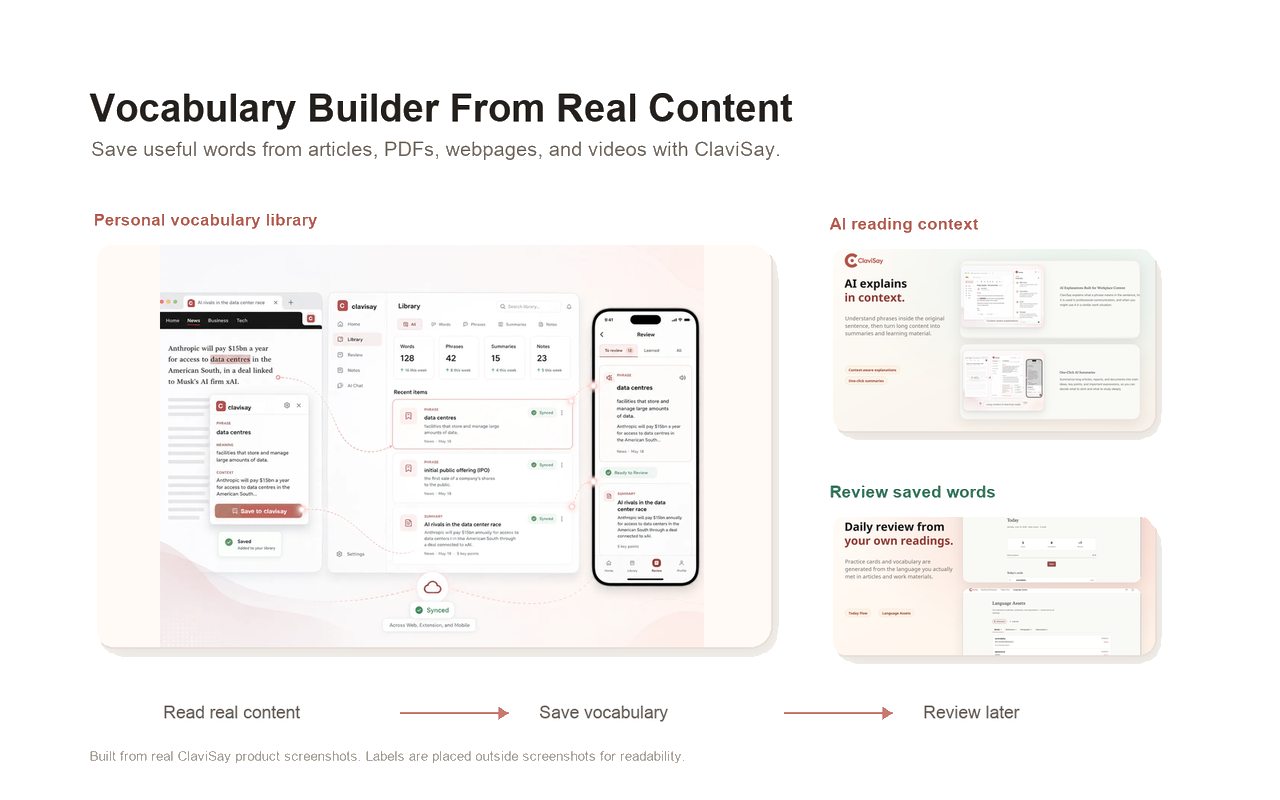
The best vocabulary builder is not always the app with the longest feature list. It is the tool that fits the moment when you actually meet a new word.
For some learners, that moment happens in a classroom list. For others, it happens while reading a BBC article, opening a PDF, watching a video, checking a product update, or trying to understand a phrase in a work document. These are very different learning situations, so they should not all be solved with the same tool.
A student preparing for an exam may need repetition. A professional reading reports may need context. An advanced learner may already understand basic definitions but still struggle with phrases, tone, and usage. Before choosing a vocabulary builder, it helps to ask one practical question: where does your vocabulary come from?
What Makes a Good Vocabulary Builder?
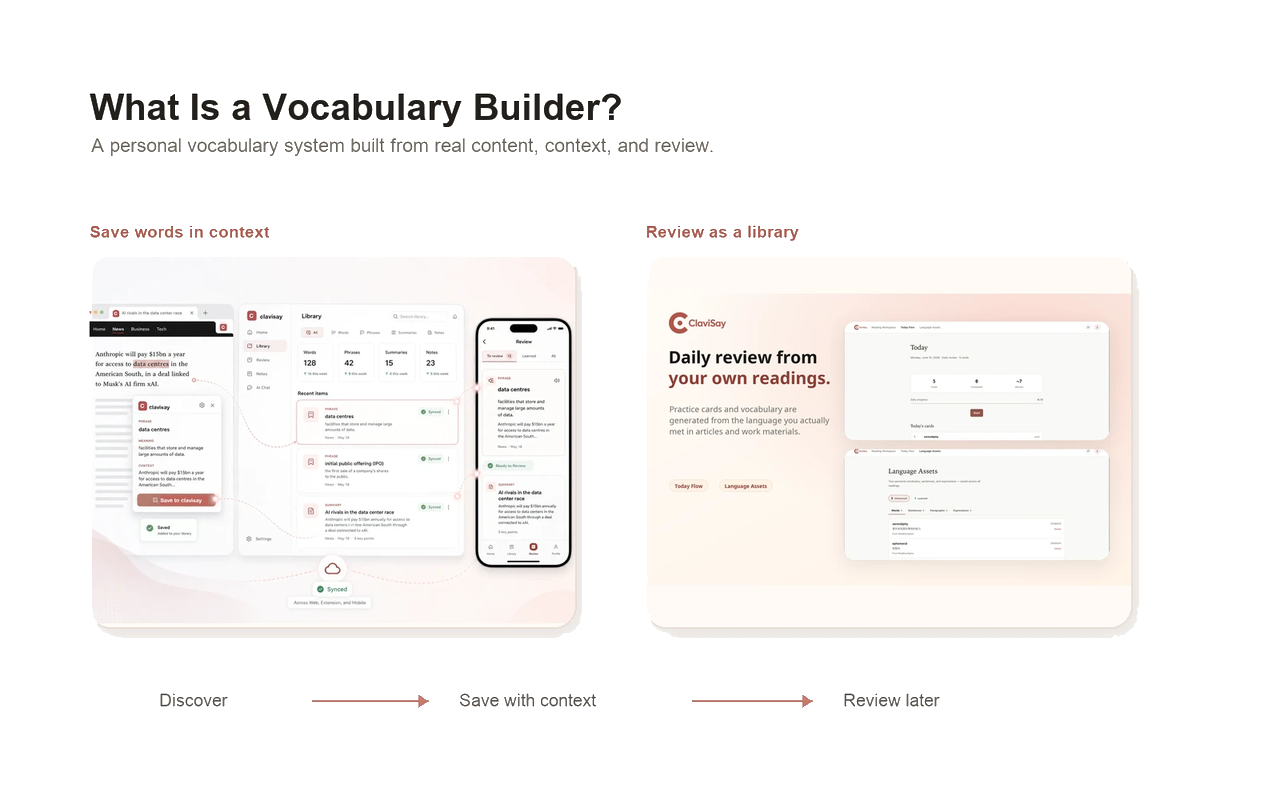
A good vocabulary builder should do more than store words. At minimum, it should help you understand a word, remember it, and use it later. The better tools also preserve the context where the word first appeared.
Useful features include:
- clear definitions
- example sentences
- flashcards or review activities
- spaced repetition
- pronunciation support
- personal word lists
- phrase and collocation support
- context from real content
That last point is easy to overlook. Many learners already have vocabulary lists. The problem is that those lists are disconnected from real use. They save "approach," "pressure," or "issue," but later cannot remember how the word worked in the sentence where they found it.
For this reason, the best vocabulary builder for many intermediate and advanced learners is not just a flashcard app. It is a system for keeping meaning, context, and review together.
Anki: Best for Custom Spaced Repetition
Anki is one of the strongest tools for learners who want full control. You can create your own cards, add example sentences, include audio, and use spaced repetition to review words over time.
The advantage is flexibility. If you are disciplined and like building your own system, Anki can be extremely powerful. You decide what goes into each card and how detailed it should be.
The trade-off is friction. Many learners spend more time managing cards than learning from them. If you read an article and want to save a useful phrase, you often need to copy the word, sentence, definition, and example into a separate workflow. That works for serious users, but it can feel heavy if you simply want to keep reading.
Quizlet: Best for Simple Flashcards and Shared Study Sets
Quizlet is popular because it is easy to understand quickly. Students can create flashcard sets, study definitions, test themselves, and use shared decks made by other learners.
It is especially useful for school vocabulary, exam terms, and subjects where the word list is already defined. If your teacher gives you a list, or if you are reviewing standard academic vocabulary, Quizlet can be a convenient option.
The limitation appears when vocabulary does not come from a fixed list. Quizlet is good at helping you practice a set, but it does not automatically connect vocabulary to the article, report, or webpage where you found the word. For learners who want to build vocabulary from daily reading, this can feel incomplete.
Memrise: Best for Course-Based Vocabulary Practice
Memrise is useful for learners who like guided courses and a more structured experience. It can help with common words, phrases, and language patterns, especially for beginners and lower-intermediate learners.
The strength of Memrise is motivation. It gives structure, repetition, and a sense of progress. If you struggle to study consistently, a course-based tool can help you keep moving.
But if your vocabulary needs come from real content, the structure can also be limiting. A course may teach useful words, but not necessarily the words you just met in a report, article, or work document.
Vocabulary.com: Best for Definitions and Word Exploration
Vocabulary.com is strong when you want to understand a word more deeply. Its explanations are often more learner-friendly than a traditional dictionary, and it can help you explore related meanings.
This is useful when you meet a word and want a clear explanation. It is also helpful for learners who enjoy expanding their vocabulary through word knowledge.
The main gap is workflow. Looking up a word is only one part of vocabulary learning. You still need a way to save the word, keep the original sentence, review it later, and connect it to your own reading history.
ClaviSay: Best for Building Vocabulary from Real Content
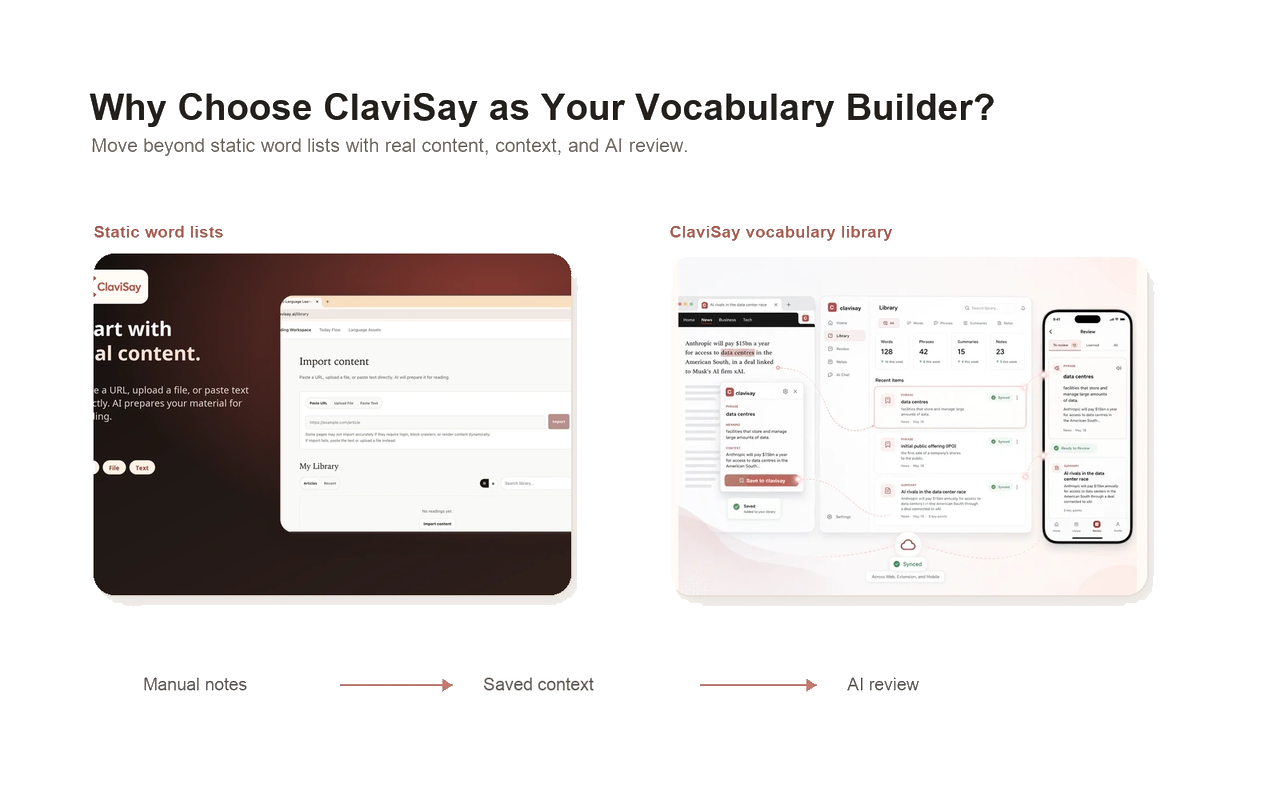
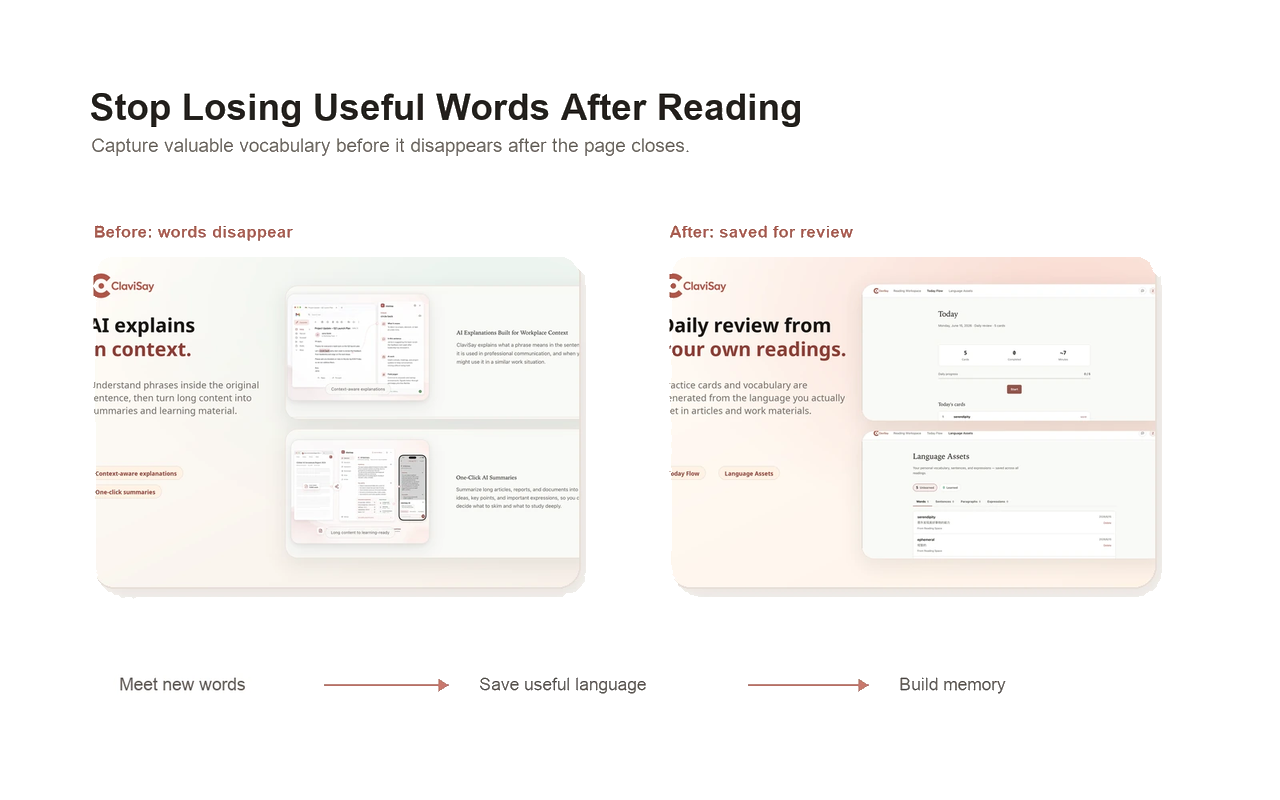
ClaviSay takes a different starting point. Instead of asking you to study a fixed word list first, it begins with the English you already read, watch, and use.
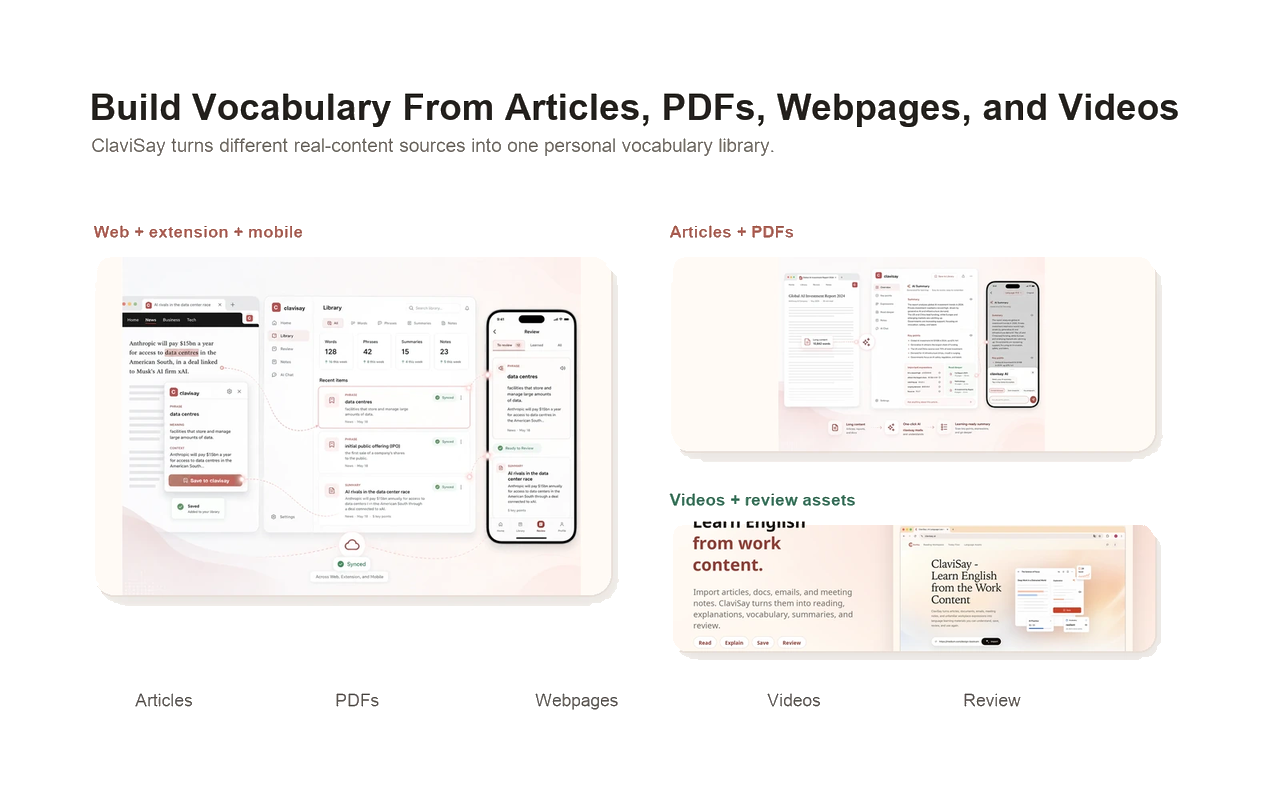
That can include articles, PDFs, webpages, videos, work documents, and study materials. When a useful word or phrase appears, you can save it with context and return to it later for review.
This matters because real vocabulary learning often happens in the middle of another task. You are reading a BBC article, checking a product update, going through a PDF, or trying to understand an unfamiliar phrase in a work document. If the tool helps you save the word at that moment, with the original sentence, the learning process feels less like extra study and more like a natural part of reading.
ClaviSay is a good fit if you want an AI Language Learning Assistant that connects reading, explanation, saving, and review. It is especially useful for learners who do not want to manually move words between a browser, dictionary, notes app, and flashcard tool.
Which Vocabulary Builder Should You Choose?
If your goal is exam memorization, Quizlet or Anki may be enough. If you enjoy custom cards and spaced repetition, Anki is hard to beat. If you want guided courses, Memrise is a strong option. If you want rich definitions, Vocabulary.com is useful.
But if your vocabulary comes from real English content, choose a tool that protects context. The word itself is only part of the learning. The original sentence, phrase pattern, topic, and review process matter too.
This is why a vocabulary builder should match your real learning environment. If you read articles every day, your tool should work with articles. If you study PDFs, it should work with PDFs. If you learn from videos or webpages, it should help you capture useful language from those sources.
A Simple Decision Guide
Choose Anki
If you want full control and do not mind building cards manually.
Choose Quizlet
If you want simple flashcards and shared study sets.
Choose Memrise
If you want a guided, course-like experience.
Choose Vocabulary.com
If you want strong definitions and word exploration.
Choose ClaviSay
Choose ClaviSay if you want to build vocabulary from real content and keep words connected to their original context.
Final Thoughts
The best vocabulary builder is the one you will actually use when new words appear. For many learners, that moment happens while reading an article, opening a PDF, watching a video, or working through an English document.
A strong vocabulary system should not force you to leave that moment behind. It should help you understand the word, save the sentence, review later, and eventually use the language yourself.
If you want a broader strategy before choosing a tool, start with How to Build Vocabulary. If your main challenge is understanding meaning inside sentences, read Learn Vocabulary in Context.
The tool matters, but the workflow matters more. Build from real language, keep the context, and review what you actually read.