Many learners do not have a “small vocabulary” problem. They have a context problem. You may know hundreds or even thousands of English words, but still hesitate when those words appear in real articles, emails, reports, or conversations. You recognize the word, but the sentence still feels unclear. You look up the meaning, understand it for a moment, and then forget it a few days later.
That happens because words do not work like isolated labels. They change slightly depending on where they appear. “Sharp” means one thing in “a sharp knife,” another in “a sharp increase,” and something different again in “a sharp comment.” “Drive” is simple when someone drives a car, but less obvious when a company “drives growth” or a new policy “drives change.”
If you want vocabulary that stays with you, the goal is not to collect more definitions. The goal is to understand how a word behaves inside real language.
What Does It Mean to Learn Vocabulary in Context?
To learn vocabulary in context means learning a word together with the sentence, paragraph, topic, and situation where it appears. Context is not just a sample sentence under a dictionary definition. It is the reason the word makes sense.
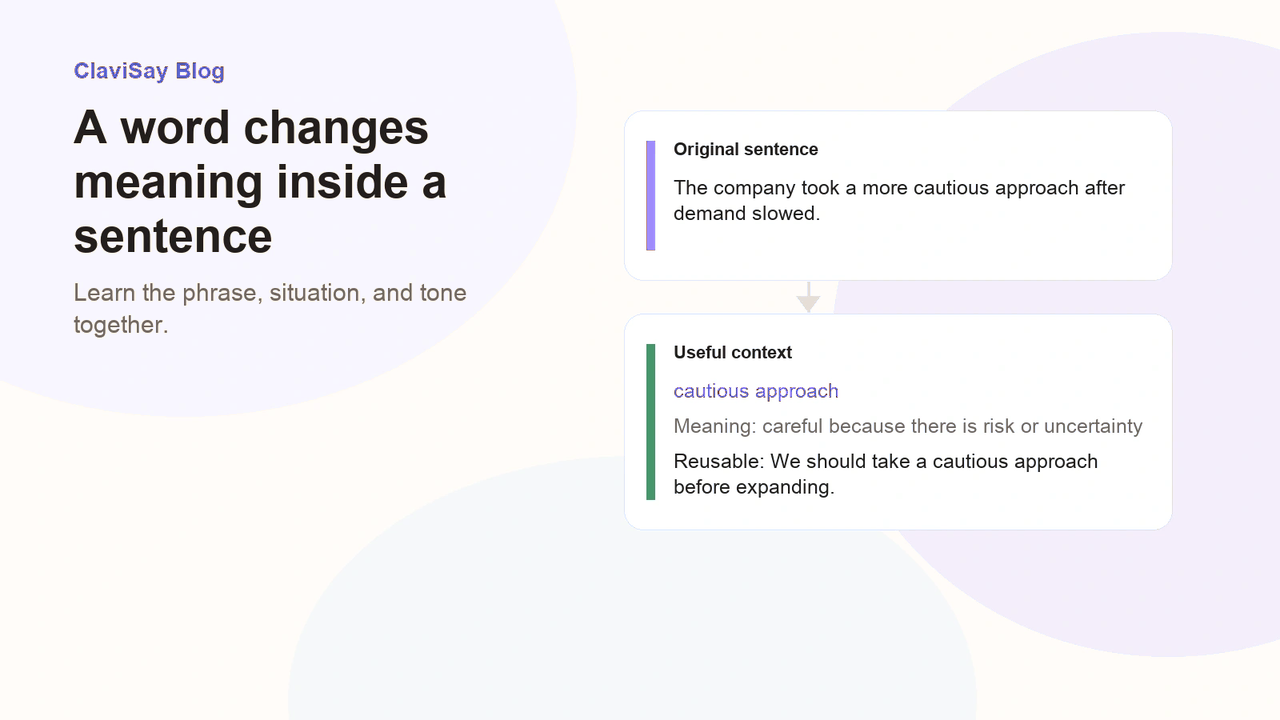
For example, imagine you read this sentence in a business article: “The company took a more cautious approach after demand slowed in the second quarter.”
If you only save “cautious = careful,” you have learned something, but not enough. The more useful part is the phrase “a cautious approach.” You also learn the situation: a company is slowing down because demand is uncertain. That gives the word a shape you can reuse.
You might write your own sentence: “We should take a cautious approach before expanding into a new market.” Now “cautious” is no longer just a translation. It is part of a phrase, a situation, and a sentence pattern.
Why Word Lists Often Feel Easy but Do Not Last
Word lists feel productive because they are clean. You can memorize 20 words, test yourself, and see progress quickly. The trouble is that a list often removes the very thing that made the word meaningful.
When you meet a word in an article, you also see the topic, the sentence structure, the writer’s attitude, and the words around it. A plain list strips all of that away. Later, when the same word appears in a new sentence, you may recognize it but still feel unsure about how it is being used.
This happens a lot with flexible English words. “Address” can mean a location, but it can also mean dealing with a problem. “Position” can refer to a place, an opinion, or a job. “Issue” can mean a topic, a problem, or a published edition. These words are hard to master from definitions alone.
This is why a contextual vocabulary habit usually beats a bigger list. The point is not to save every unknown word. The point is to save the words that mattered while you were reading, with enough context to understand them again later.
Start with Real Content, Not Example Sentences
Example sentences are helpful, but real content gives vocabulary more weight. Read the English you already care about: BBC articles, Medium essays, Substack newsletters, product updates, work documents, PDFs, research summaries, or interviews.
The source should match your real reason for learning. If you are learning English for work, a product update may be more useful than a textbook dialogue. If you are preparing for IELTS or TOEFL, opinion articles and academic summaries may give you better topic vocabulary. If you want more natural everyday English, interviews, comments, and podcasts can expose you to expressions that formal materials often miss.
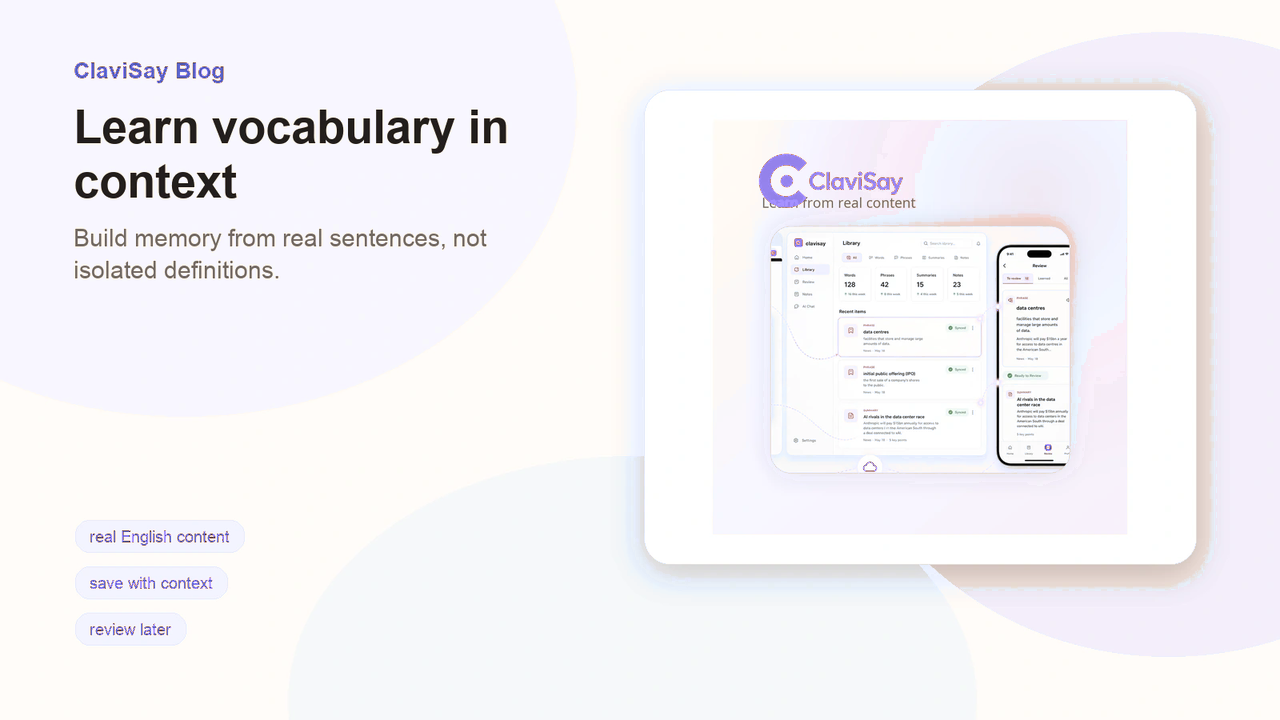
This is also where ClaviSay fits naturally into the process. Instead of separating reading, translation, notes, and review into different tools, it works as an AI Language Learning Assistant that keeps those steps connected.
ClaviSay workflow: Read real content, understand the phrase in context, save useful language, and review it later from the same source.
Guess Before You Check
Before looking up a new word, pause for a few seconds. Ask what the sentence is doing. Is it explaining a problem? Giving a contrast? Showing cause and effect? Describing a trend?
This small habit makes a big difference. If you read, “The proposal gained traction after several large clients showed interest,” you may not know “traction” immediately. But the phrase “gained traction” and the second half of the sentence suggest that the proposal became more accepted or started getting attention. When you confirm the meaning, your brain has already done some useful work.
That small effort helps memory. Instant translation is convenient, but if it becomes the only step, the word passes through your mind too quickly. Context guessing slows you down just enough to notice how the word works before you move on.
Save the Sentence, Not Just the Word
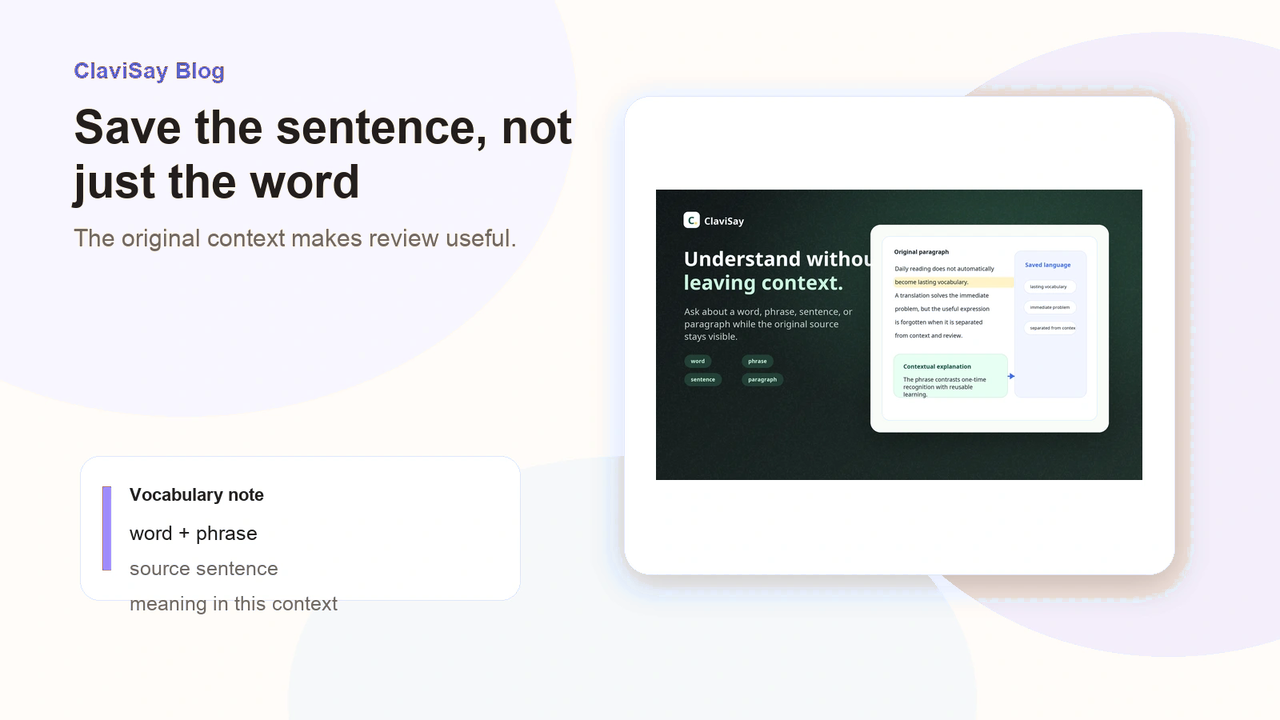
When you save vocabulary, save the original sentence. Better yet, save the phrase inside the sentence. A note like “traction = support” is not wrong, but “gain traction” from the original sentence is far more useful.
A good vocabulary note might include:
- the word or phrase
- the original sentence
- the meaning in that sentence
- one reusable phrase
- one short sentence of your own
This is the practical core of learn vocabulary in context. You are not building a private dictionary. You are building a record of language you have actually met.
A vocabulary builder is most useful when it helps preserve that record. If the word, source sentence, and review process stay connected, you can return to the word later and still understand why you saved it.
Review by Returning to the Original Context
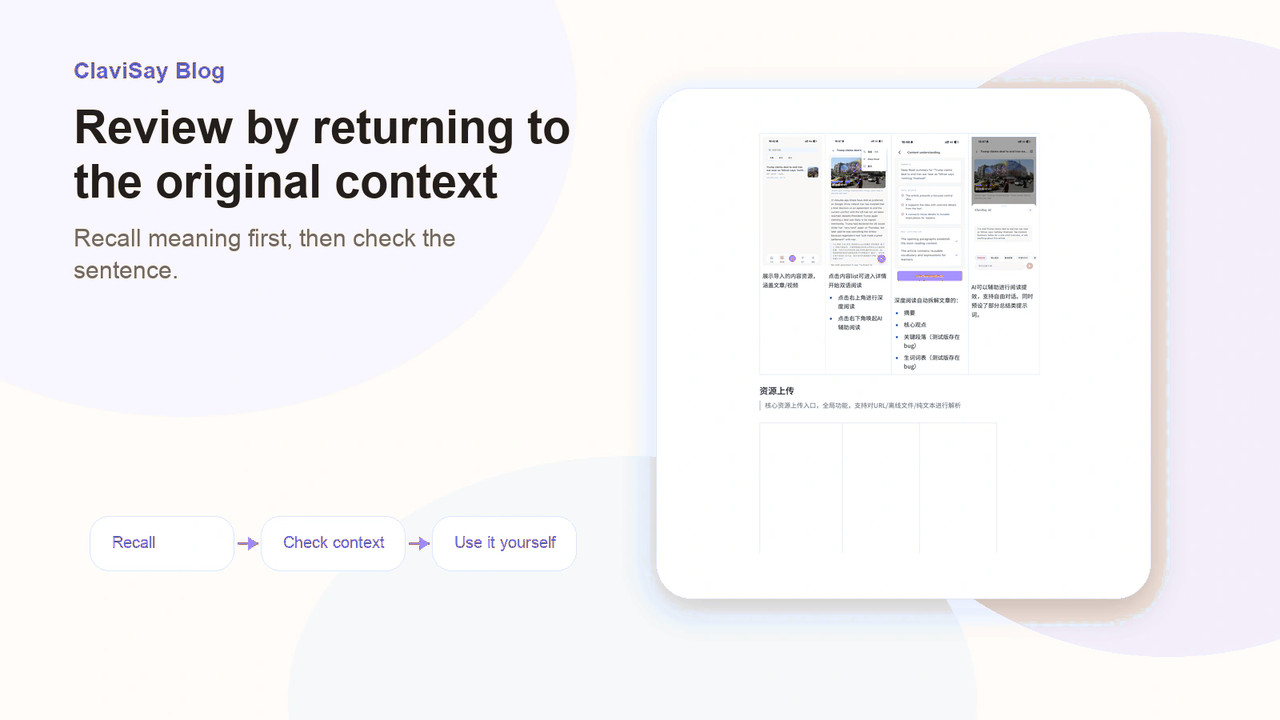
Review should not only mean looking at the word and checking the translation. A better review starts with the original moment. Try to remember what the word meant in the sentence where you found it, then look back and test your memory.
For example, if you saved “a cautious approach,” ask yourself: what was cautious about it? Was it about risk, speed, cost, or uncertainty? When you answer that question, you are reviewing meaning, not just spelling.
You can also make the word active by writing one sentence of your own. This is especially useful for words you want to use in work, essays, presentations, or conversations.
Build a Small Context-Based Vocabulary Routine
You do not need a complicated system. A small routine is easier to keep:
- Read one real English article or document.
- Mark 5 to 8 useful words or phrases.
- Guess the meaning from context before checking.
- Save the word with the original sentence.
- Review later by recalling the context.
- Write one sentence of your own with the best words.
This routine works because it fits into reading you already do. It turns real English content into vocabulary practice without turning every article into homework.
If you also want a broader workflow for improving vocabulary, read How to Build Vocabulary. If your goal is to compare tools, you may also find Best Vocabulary Builder useful.
Final Thoughts
The vocabulary you remember best is often the vocabulary you met while trying to understand something real. A word from a sentence you cared about has more weight than a word from a random list.
So the next time you read an article, do not rush to save every unknown word. Choose the ones that matter. Look at the sentence. Notice the phrase. Save the context. Review it later. Then try using the word yourself.
That is how vocabulary stops being something you recognize once and starts becoming language you can actually use.
Ready to keep source sentences and reviews connected? Try Vocabulary Builder.