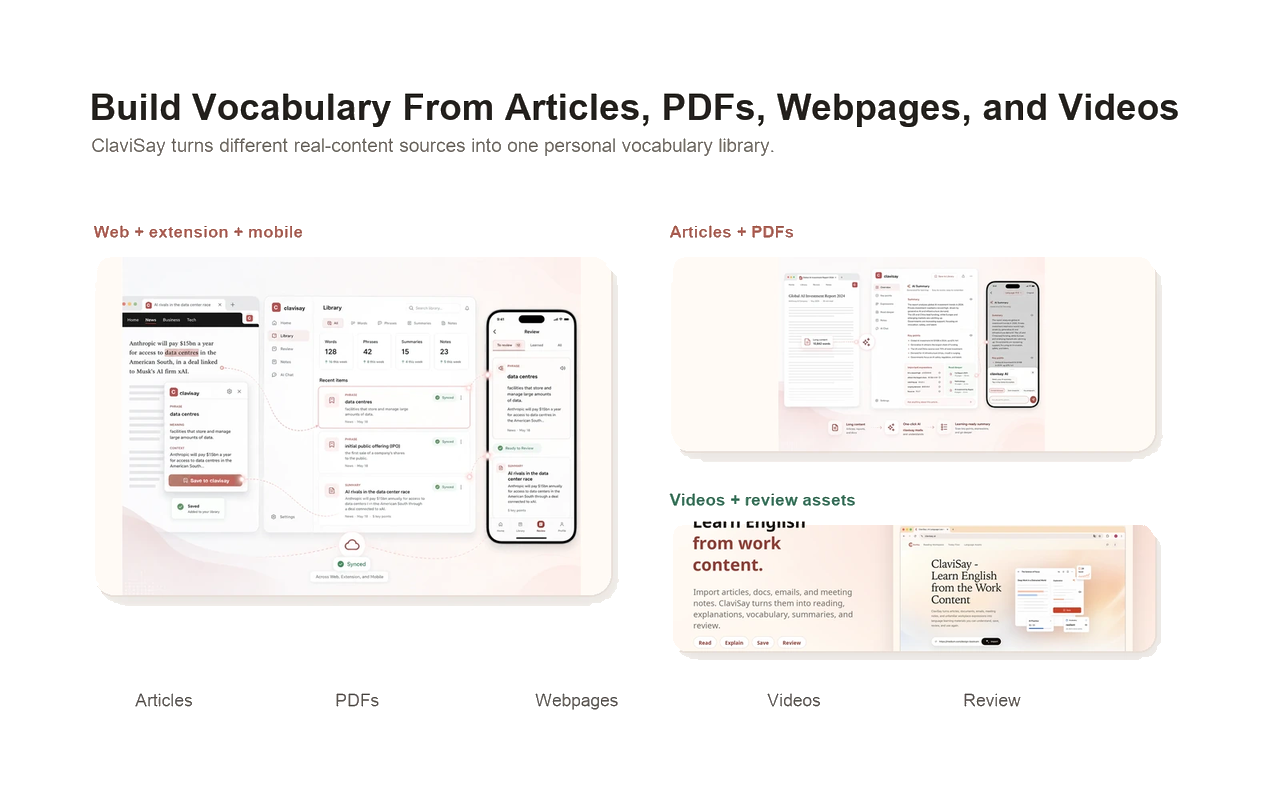
Reading English articles is one of the most natural ways to grow your vocabulary. The problem is that reading alone does not automatically become vocabulary learning. You may read a BBC article in the morning, skim a Medium post during lunch, open a Substack newsletter at night, or go through a work document because you need the information. You understand enough to move on, maybe look up a few words, and then the useful language disappears. The article helped you in the moment, but it did not leave much behind.
If you want to build vocabulary while reading English articles, the answer is not to stop at every unknown word. That kills the reading experience. A better approach is lighter: read for meaning, notice useful language, save a few words with context, review later, and try using the best expressions yourself.
Read for the Main Idea First
A common mistake is treating every English article like a vocabulary test. You start reading, meet an unfamiliar word, stop, look it up, copy the meaning, return to the article, and then stop again two sentences later. After a few minutes, you are no longer reading. You are managing interruptions.
Try reading the article once for the main idea first. You do not need to understand every word. You only need to understand what the article is about, what problem it discusses, and what the writer is trying to say.
This matters because vocabulary makes more sense after you understand the topic. If an article is about inflation, words like "pressure," "forecast," "households," and "slowdown" become easier to understand. If an article is about productivity, phrases like "deep work," "attention span," and "mental clutter" feel less random.
Once you understand the topic, the vocabulary has a place to live. Words stop feeling random because they are connected to an idea.
Do Not Save Every Unknown Word
Not every unknown word is worth saving. Some words are rare, too technical, or not useful for your goals. If you save everything, your vocabulary list becomes too long to review, and the habit quickly becomes tiring.
A better rule is to save words that meet at least one of these conditions:
- the word affects your understanding of the article
- the word appears more than once
- the phrase feels useful for your writing or speaking
- the word belongs to a topic you care about
- the expression sounds natural and reusable
From a BBC article, you might save "a sharp rise," "household spending," or "economic pressure." From a Medium essay, you might save "creative momentum," "a practical trade-off," or "the main takeaway." From a work document, you might save phrases like "align on priorities," "reduce friction," or "follow up on this."
The best vocabulary is not always the most difficult vocabulary. It is the language you are likely to meet again or want to use yourself.
Guess the Meaning from Context
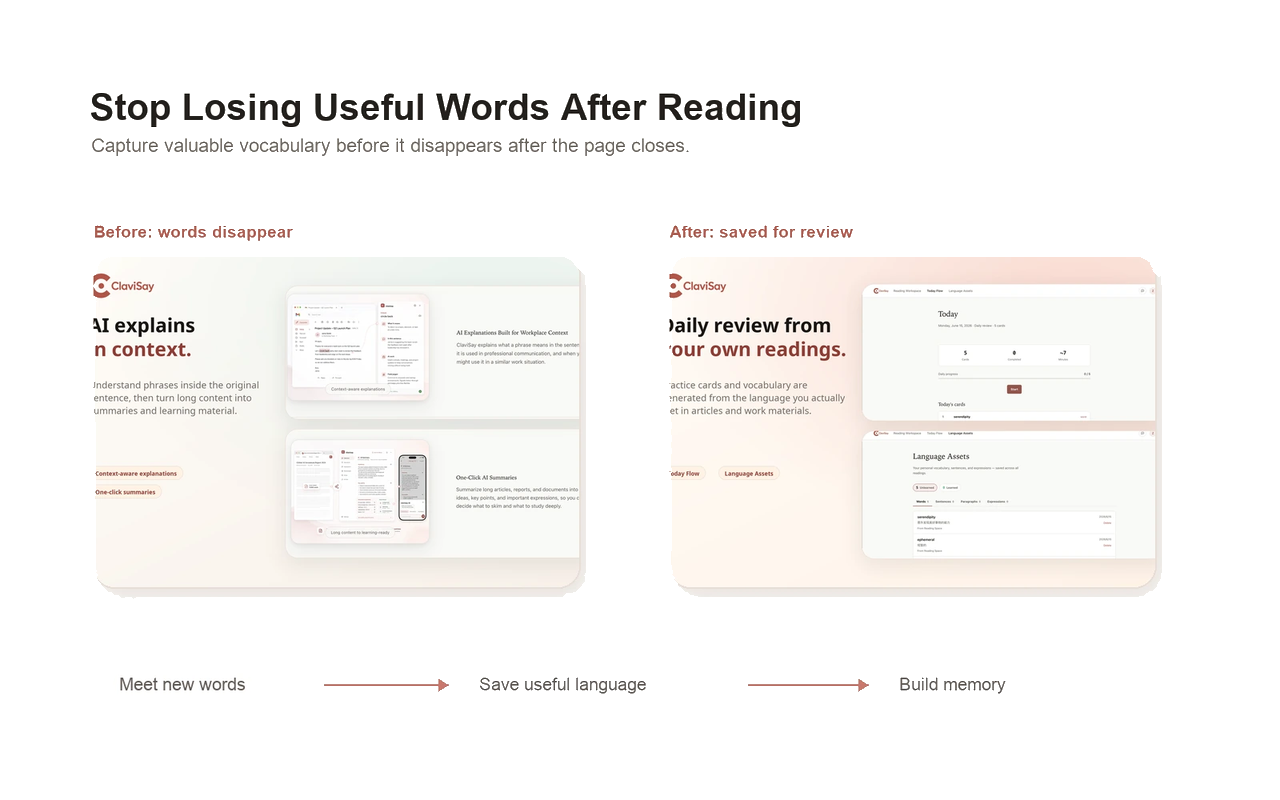
Before checking a dictionary or translation, look at the sentence. What is happening around the word? Is the writer describing a cause, a result, a contrast, or a trend?
For example: The new policy put additional pressure on small businesses.
Even if you are unsure about "pressure," the rest of the sentence tells you it is probably something difficult or demanding. When you confirm the meaning later, the word is easier to remember because you already worked with the context.
This is one of the most important habits for learners who want to build vocabulary while reading English articles. It trains you to use the article itself as a learning tool, instead of depending on translation alone.
Save the Original Sentence
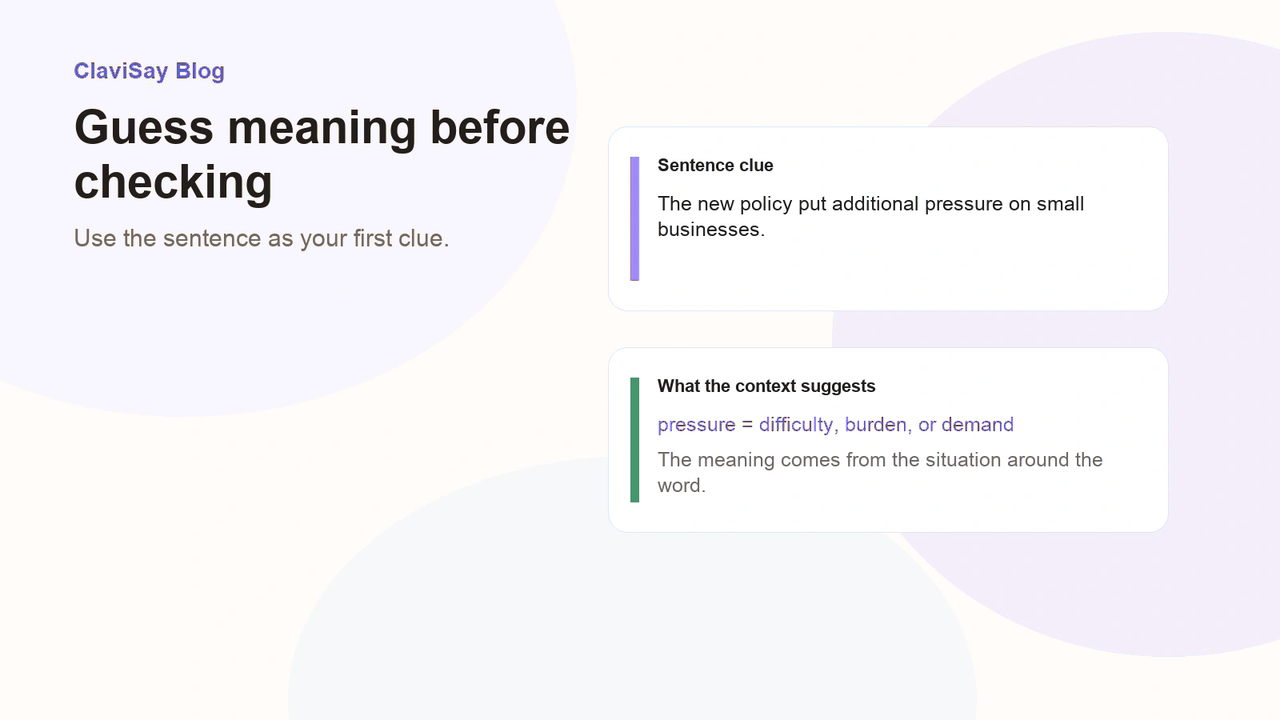
A word saved without context is easy to forget. A word saved with the original sentence is much more useful because it carries a memory of where you saw it.
Instead of writing: resilient = able to recover
Save something like: The team remained resilient despite several setbacks.
Now you can see the word inside a real situation. You also learn that "resilient" often describes people, teams, systems, communities, or businesses that recover after difficulty.
If you want to go one step further, save a phrase rather than only the word. "Remain resilient," "economic pressure," "a cautious approach," and "gain momentum" are often more useful than single words. English fluency depends heavily on these small patterns.
Build a Short List from Each Article
A useful article does not need to produce a huge vocabulary list. In fact, a short list is usually better.
After reading, choose 5 to 8 words or phrases. That is enough to review without feeling buried. If you read one or two articles a day, this small habit can create a strong vocabulary record over time.
Your list might include:
- one word that was essential to the article
- two or three useful phrases
- one expression you want to use in writing
- one topic-specific term
- one sentence pattern worth remembering
This turns every article into a small vocabulary lesson without making reading feel mechanical.
Review After Reading
Trying to memorize while reading can break your focus. It is better to save useful vocabulary during reading and review after you finish.
When reviewing, do not only look at the translation. Ask yourself:
- What did this word mean in the article?
- What phrase did it appear in?
- Why did I save it?
- Can I write my own sentence with it?
This kind of review is active. You are not just recognizing the word; you are rebuilding the context.
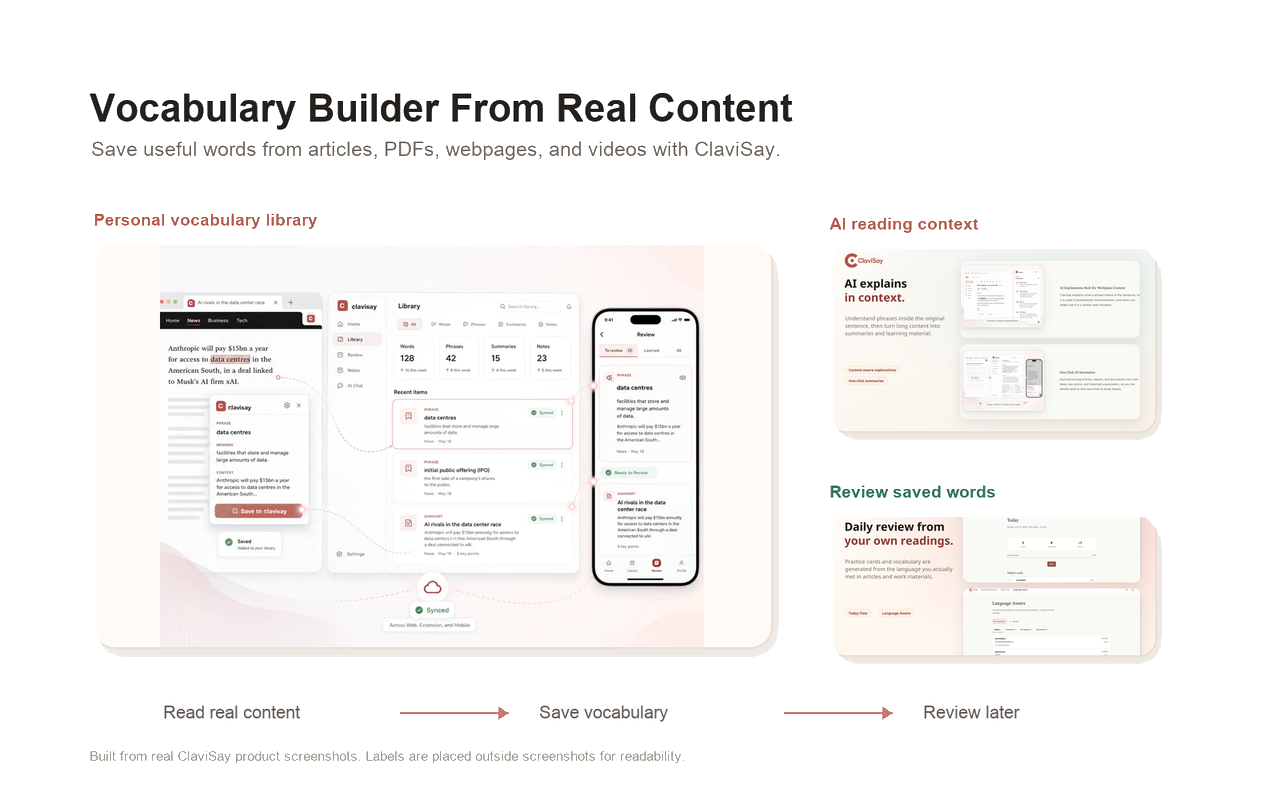
A tool like ClaviSay can support this workflow because it keeps reading, vocabulary saving, and review connected. You can save useful language from real content and return to it later without rebuilding the context manually.
ClaviSay workflow: Try the Vocabulary Builder or open a article reading workflow to see how reading context can become review material.
Use the Vocabulary in Your Own Writing
The final step is simple but often skipped: use the word yourself.
If you saved "economic pressure," write a sentence like: Rising rent has put economic pressure on many young workers.
If you saved "gain momentum," write: The project gained momentum after the first customer interview.
These sentences do not need to be perfect. The point is to move from recognition to use. A word becomes part of your vocabulary when you can bring it into your own expression.
A Practical Reading Workflow
Here is a simple workflow you can use with almost any English article:
- Read the article once for the main idea.
- Mark only useful words and phrases.
- Guess meaning from context before checking.
- Save the original sentence.
- Keep a short list of 5 to 8 items.
- Review after reading.
- Write your own sentence with the best words.
This is more sustainable than trying to memorize hundreds of disconnected words. It works because it starts from content you already read. If you need a broader strategy, read How to Build Vocabulary. If you want a tool-based workflow, see Vocabulary Builder.
Final Thoughts
English articles are full of vocabulary, but the words will not stay with you automatically. You need a light system: read, notice, save, review, and use.
Do not turn every article into a dictionary exercise. Read for meaning first. Choose the words that matter. Keep the sentence. Review later. Then try using the language yourself. That is how everyday reading becomes long-term vocabulary growth.
Turn Your Next Article into Vocabulary You Can Keep
Start with a real article, save the language that matters, and keep the original context connected to your review.