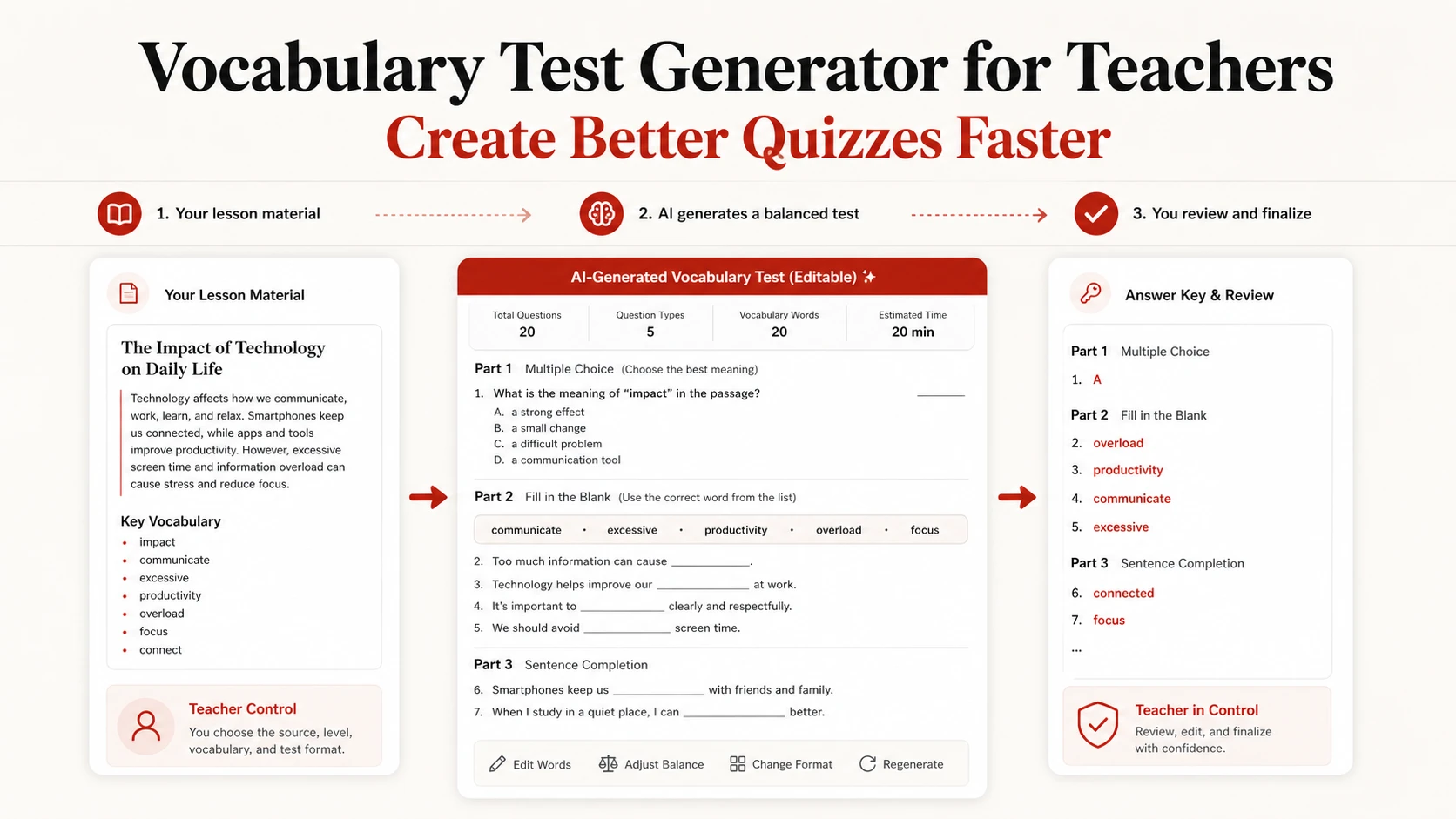
The slow part of a vocabulary test is rarely choosing the words. It is everything that follows: writing clear instructions, finding natural sentences, inventing distractors, balancing difficulty, formatting the page, and producing an answer key.
A vocabulary test generator for teachers can shorten that work considerably. But speed is only useful when the finished test measures what students were actually taught. A generated worksheet with ambiguous answers creates more marking problems than it solves.
This guide explains how to use a generator as a careful first-draft assistant. The goal is not to hand assessment decisions to software. It is to spend less time formatting and more time deciding what evidence of learning you need.
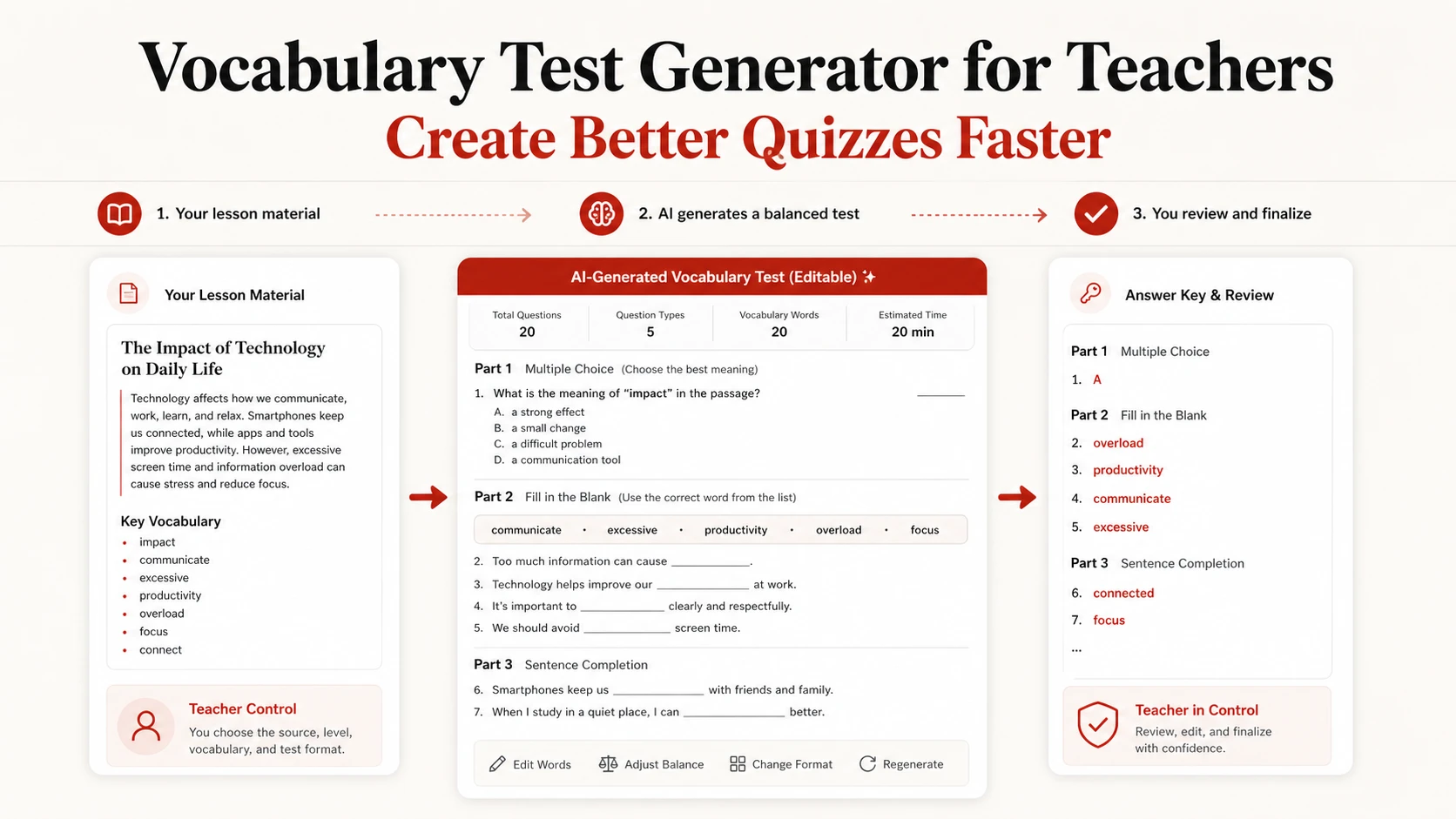
What Should a Vocabulary Test Measure?
Before opening a tool, decide what “knowing the word” means in this lesson. A student may recognize a definition without being able to choose the word in a sentence. They may understand the base form but miss the adjective. They may know the meaning but combine the word with the wrong preposition.
A useful vocabulary test can sample several layers of knowledge:
- meaning recognition;
- recall from a definition or context clue;
- appropriate use in a sentence;
- common collocations;
- grammatical form and word family;
- spelling, where spelling is part of the objective;
- productive use in a short response.
Not every weekly quiz needs all seven. The point is to choose deliberately rather than letting the generator fill the page with whichever question type is easiest to produce.
A Practical Test Blueprint
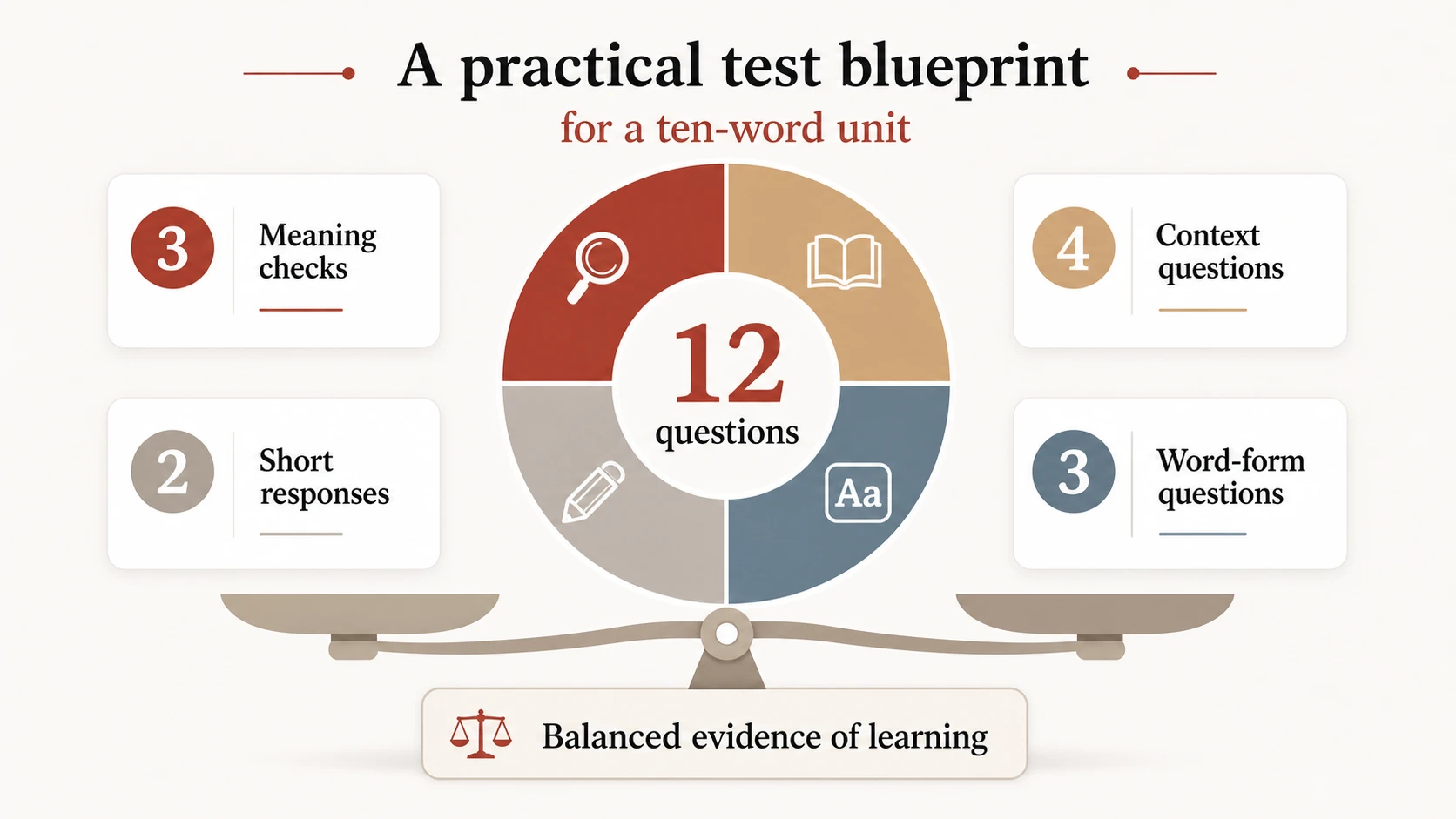
For a ten-word unit, a short 12-question assessment might include:
This mix is not a rule. Beginners may need more recognition support, while advanced learners can handle subtler context and production. A blueprint simply prevents twelve near-identical multiple-choice questions from masquerading as a comprehensive test.
How to Use a Vocabulary Test Generator for Teachers
Step 1: Prepare clean source material
Give the generator the exact terms you taught. For each word, include the relevant meaning and one natural sentence. If the class learned issue as “a problem,” say so; otherwise the tool may test “an edition of a magazine.”
Material can come from a lesson, article, textbook passage, or PDF. When vocabulary comes from authentic reading, keep enough of the original context to show tone and usage.
Step 2: Specify the learners
Include grade or proficiency level, subject, and any constraints. “Create a vocabulary test” is vague. “Create a 12-question B1 English quiz for adult learners using these ten target words” gives the generator a much clearer job.
Step 3: Request a question mix
Ask for the blueprint you want rather than accepting a default. State the number of matching, multiple-choice, fill-in-the-blank, and short-answer questions. Request an answer key separately.
Step 4: Review every generated item
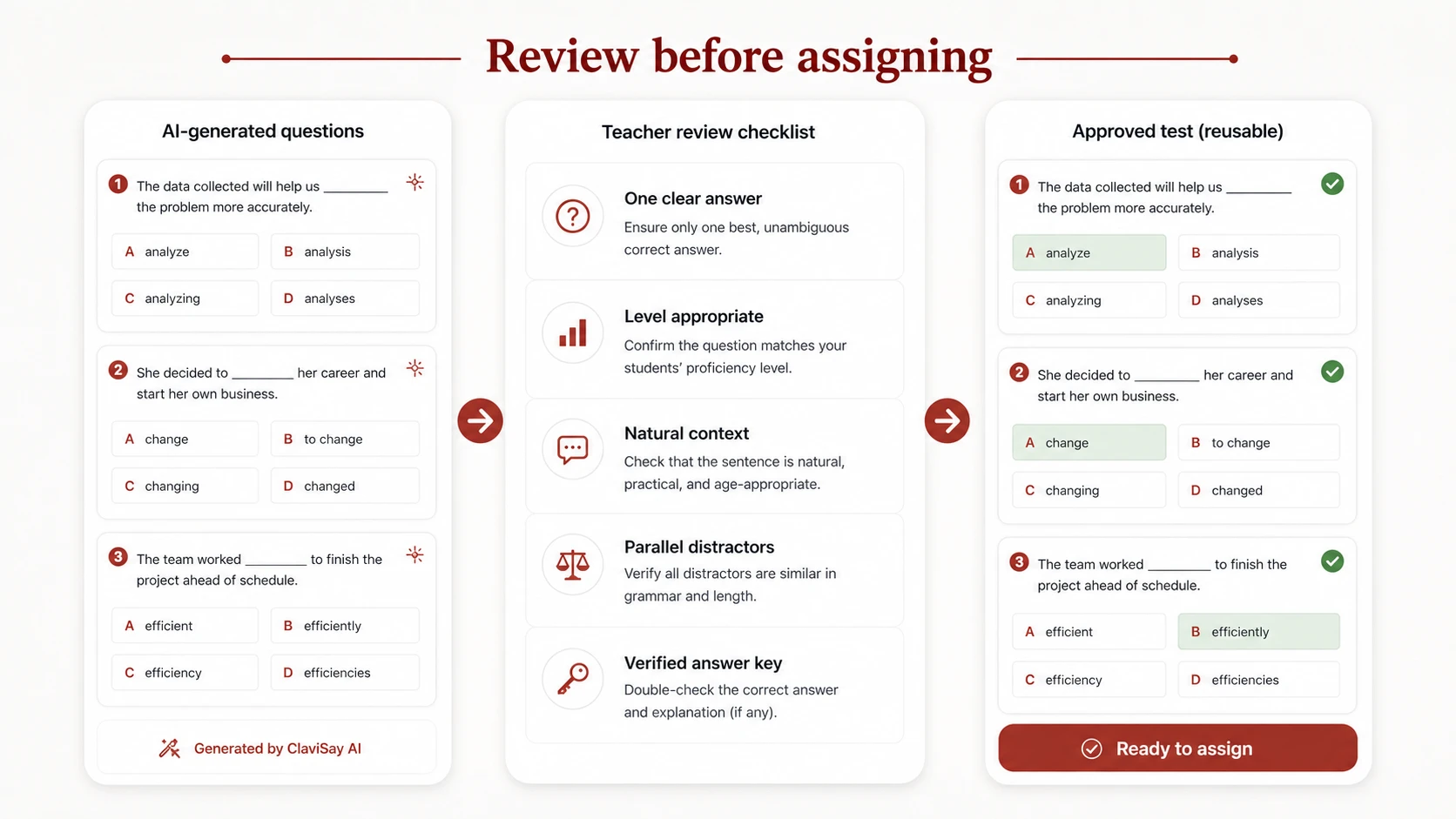
Read the test as a student. Is there one defensible answer? Does the sentence contain enough information? Are the distractors parallel in grammar? Is an accidental clue hiding in the wording?
Step 5: Adjust difficulty, not just vocabulary
Difficulty comes from more than word rarity. Sentence length, clue strength, similarity of distractors, time pressure, and the amount of production all matter. Change one or two variables at a time.
Step 6: Keep a reusable version
Save the reviewed test, answer key, and source list. Next term, you can change names and contexts, randomize question order, or create an alternate version without returning to a blank page.
How to Write Better Context Questions
A weak sentence offers no meaningful clue:
The situation was ______.
Many adjectives could fit. A stronger sentence makes the intended meaning visible without simply defining it:
Because the two reports gave different totals, the manager asked the team to ______ the figures before publishing them.
If the target is verify, the action and purpose provide a fair context. Students still need to know the word, but they are not being asked to read the teacher’s mind.
Good context questions usually contain a cause, contrast, consequence, or concrete situation. They test meaning in use rather than the ability to match two isolated labels.
Distractors: The Part AI Often Gets Wrong
Multiple-choice questions are quick to grade and surprisingly difficult to write. Wrong answers should be believable to a student who has not fully learned the distinction. They should also match the correct answer grammatically. If the blank requires a verb, all options should be verbs in a form that could fit the sentence.
Avoid distractors that are:
- obviously absurd;
- from unrelated difficulty levels;
- grammatically impossible;
- synonyms that are equally acceptable;
- longer or more specific than the correct answer in a way that gives it away.
If two teachers disagree about the key, the item needs revision. Do not expect students to resolve ambiguity that the test writer left behind.
Choosing the Right Kind of Generator
Different tools solve different classroom problems. A printable quiz maker is helpful when students need paper and a separate key. A live game platform is useful for whole-class review. A class platform can assign work and track results. A context-aware tool can help retain words from the actual texts students read. ClaviSay is relevant when teachers or learners collect vocabulary from articles, PDFs, webpages, and videos and want to keep the original context available for practice. Quizlet can create practice tests from notes and readings. Tools such as Wordwall, Kahoot!, and Quizizz emphasize reusable activities, live participation, or assignments.
The right vocabulary test generator for teachers should match the teaching environment, not merely produce the longest feature list.
A Prompt Teachers Can Reuse
Use this as a starting point and replace the bracketed details:
Create a [12]-question vocabulary test for [B1 adult English learners]. Use only the target words and meanings below. Include [3 definition matching, 4 contextual multiple-choice, 2 word-form, 2 short-answer, and 1 original-sentence question]. Make every multiple-choice item have one unambiguous answer and grammatically parallel options. Keep instructions concise. Provide a separate answer key and a one-sentence rationale for each contextual answer. Flag any source word that is too ambiguous to test reliably.
The final instruction is important. A responsible generator should be allowed to admit uncertainty rather than invent a neat but unreliable question.
Using Results to Plan the Next Lesson
A vocabulary test is not only a grade. It is a small sample of what students can retrieve. If many students miss the same definition item, reteach the core meaning. If they recognize meanings but fail sentence completion, return to context and collocation. If productive answers are understandable but awkward, compare several natural examples instead of repeating the translation. Patterns matter more than one score. Keep frequently missed words in future warm-ups and cumulative quizzes. A generator makes alternate questions cheap, so use that advantage for spaced retrieval rather than giving the same worksheet again.
For more on moving beyond recognition, read what is generative vocabulary and how to learn vocabulary in context. Teachers building a larger capture-and-review workflow can also explore the vocabulary builder.
Common Mistakes to Avoid
Do not test meanings that were never taught unless inference is the explicit objective. Do not let an AI-generated sentence introduce cultural assumptions or unnecessary background knowledge. Do not use a rare word in every distractor simply to make the test appear advanced. Most importantly, do not publish the first draft. A vocabulary test generator for teachers saves the mechanical work; it does not know the students, the lesson, or the conversation that happened in class.
Frequently Asked Questions
Can a vocabulary test generator create an answer key?
Most quiz generators can produce one, but teachers should verify every answer. This is especially important for context questions and synonyms, where more than one response may be reasonable.
What question types work best for vocabulary?
A combination works best. Recognition questions efficiently sample breadth, while sentence completion, word forms, and short production reveal whether students can retrieve and use the language.
Should vocabulary tests be printable or online?
Choose according to access and purpose. Paper reduces device friction and works well for formal assessment. Online tests make randomization, automatic scoring, feedback, and repeated practice easier.
How can teachers prevent students from guessing?
Use plausible distractors, include some recall questions without answer choices, and ask for brief contextual production. Guessing can be reduced, although no short quiz measures knowledge perfectly.
Is it safe to upload classroom materials to an AI generator?
Check the tool’s current privacy and data-retention policy. Remove student names, grades, and other personal information. Avoid uploading copyrighted or confidential material unless your institution permits it.
The Teacher Still Owns the Test
The best use of a generator is quiet and practical. It drafts, formats, randomizes, and produces a key. The teacher decides what matters, notices ambiguity, adjusts the level, and interprets the results.
That division of labor can turn an hour of repetitive preparation into a shorter review process without lowering standards. Faster is valuable. Faster and more deliberate is better.