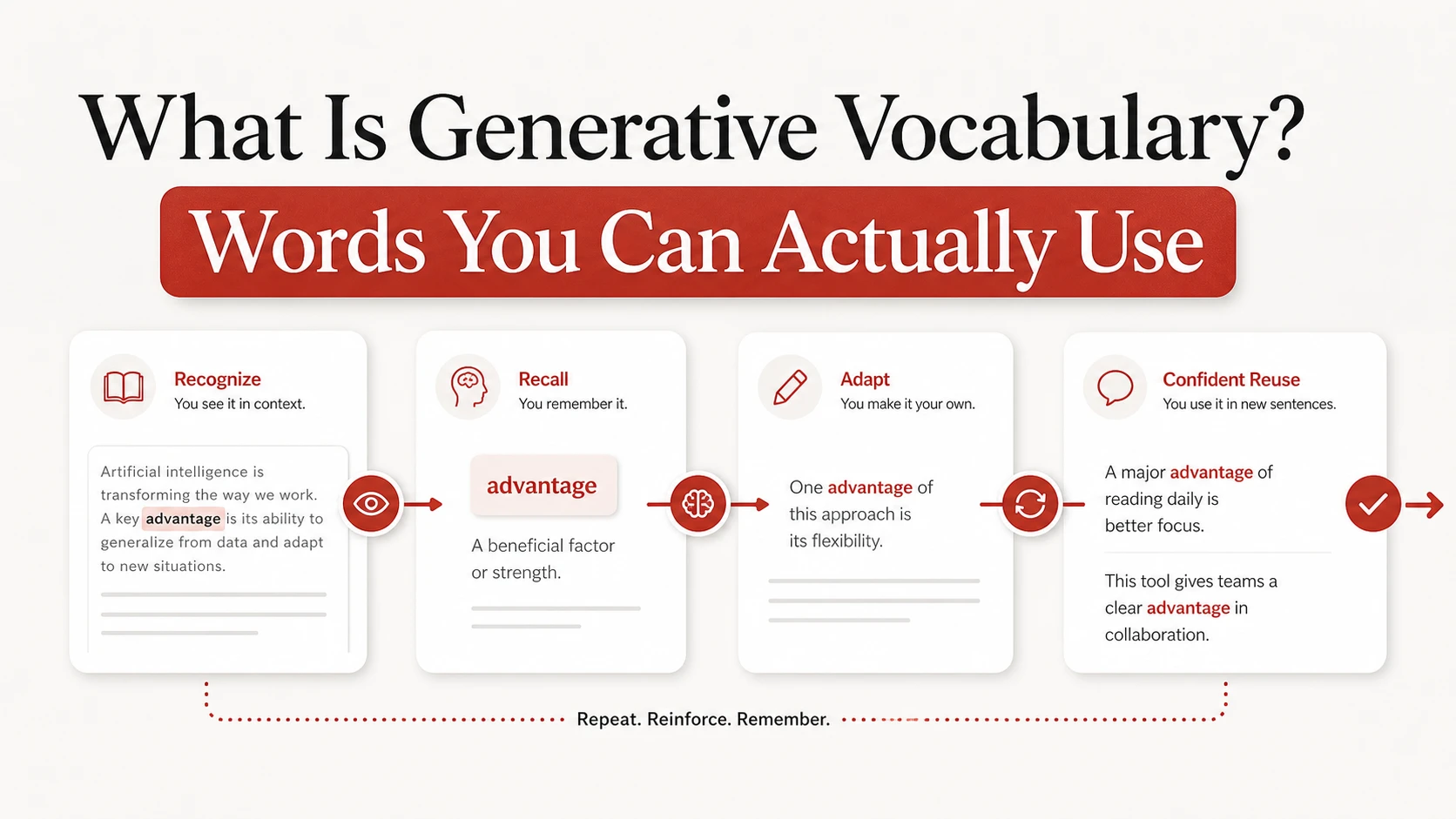
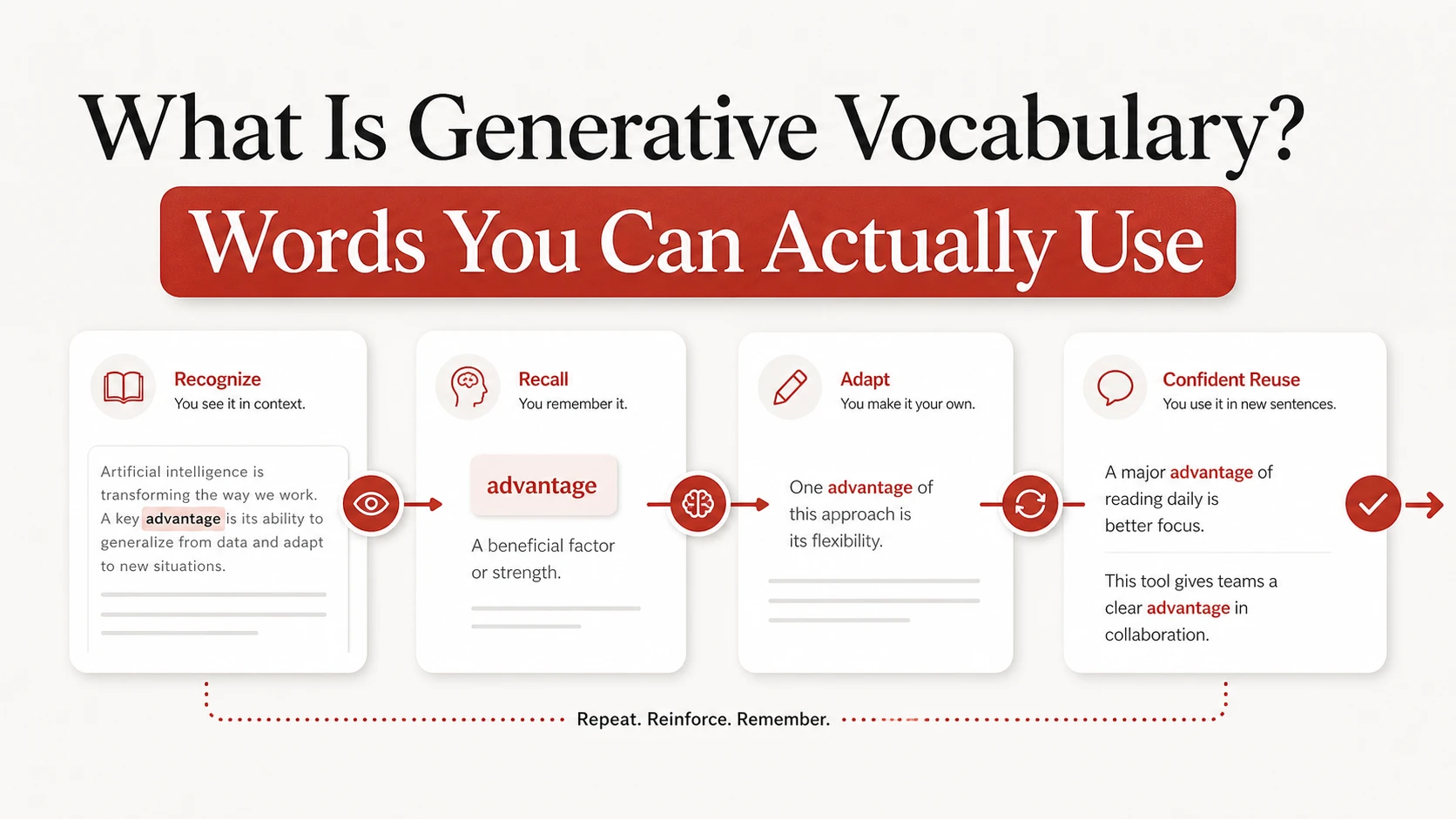
You know the word when you see it. Then you need it in a conversation, an email, or a meeting, and it disappears. That gap is familiar to almost every language learner. Recognition feels like knowledge, but recognizing a word is not the same as being able to retrieve it, adapt it, and place it naturally in a new sentence. This is where the idea of generative vocabulary becomes useful.
So, what is generative vocabulary? In practical terms, it is vocabulary you can do something with. You can recall a word without being shown it, combine it with other words, change its form when necessary, and use it across situations that are different from the one in which you first learned it. It is not simply a larger word list. It is a more flexible relationship with the words you already know.
What Does “Generative” Mean in Vocabulary Learning?
“Generative vocabulary” is best understood as a practical learning concept rather than a single, universally fixed technical label. In vocabulary research and teaching, you will more often see distinctions such as receptive vocabulary and productive vocabulary.
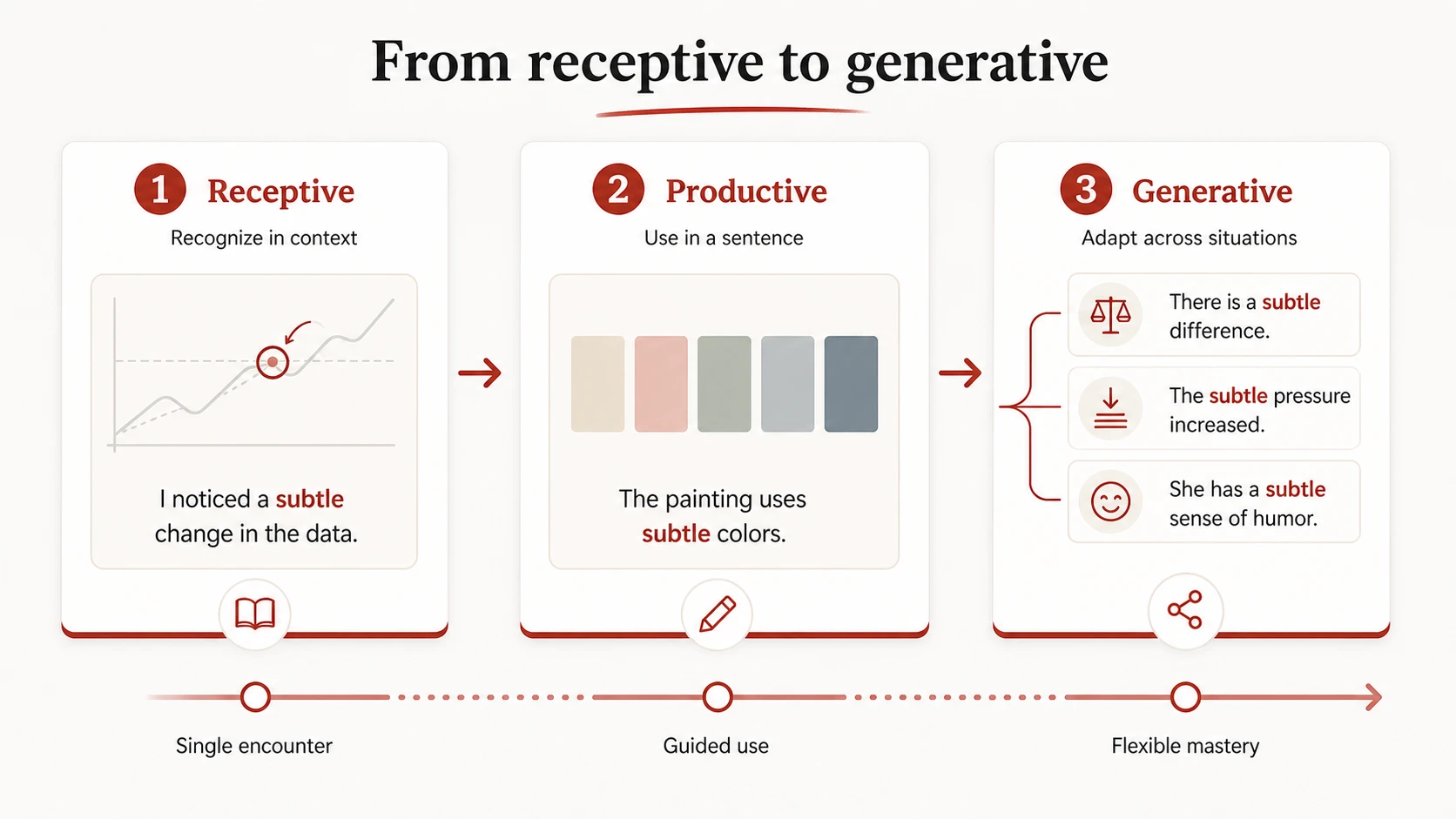
Receptive vocabulary includes words you understand while reading or listening. Productive vocabulary includes words you can retrieve and use while speaking or writing. Generative use goes a step further: it emphasizes whether you can use a known word flexibly in a fresh context.
Imagine that you meet the word subtle in this sentence:
There was a subtle change in her tone.
If you understand the sentence, subtle is part of your receptive vocabulary. If you can later write, “The design uses subtle colors,” you are using it productively. If you can also say “a subtle difference,” “subtle pressure,” or “The humor is too subtle for some viewers,” you are beginning to use the word generatively. The word is no longer tied to one definition or one example. You understand the pattern well enough to produce new, plausible combinations.
Generative Vocabulary vs. Passive and Active Vocabulary
The easiest way to see the difference is to follow one word through three stages.
These stages are not rigid boxes. A word may be highly generative in your professional life but only passive in another setting. A designer may use hierarchy confidently when discussing interfaces, yet hesitate when the word appears in politics or biology.
This explains why vocabulary size alone can be misleading. Two learners may recognize the same number of words, while only one can use those words to express precise, original thoughts.
Why Generative Vocabulary Matters
Most real communication does not give you a sentence to copy. You have to build one from the situation in front of you.
In a meeting, you may need to soften disagreement. In an essay, you may need to compare two closely related ideas. While reading, you may notice that a familiar word behaves differently beside a new noun. Generative vocabulary gives you room to respond rather than repeat.
It also improves comprehension. When you understand a word’s common partners, forms, and shades of meaning, you process it as part of a network. The phrase raise a concern becomes easier to recognize because you know that raise can mean “bring something up,” not only “lift something.”
This kind of knowledge supports four things at once:
- more natural writing, because you rely on common word combinations;
- more fluent speaking, because retrieval becomes faster;
- more accurate reading, because you notice meaning in context;
- longer retention, because each word has several useful connections.
Why Memorizing Definitions Is Not Enough
A definition gives you a starting point, but it leaves out much of what makes a word usable.
Take commit. A short translation might help you recognize it, but it does not tell you why people say commit to a plan, commit a crime, commit resources, or a committed team. The surrounding words change both the grammar and the meaning.
This is why isolated flashcards often create a false sense of progress. The front of the card becomes a cue, and the answer becomes familiar. Remove the cue, change the sentence, or ask the learner to produce the word, and the memory may not hold. That does not make flashcards useless. It means the card needs better material: a real sentence, a useful phrase, a note about tone, or a prompt that requires the learner to make a new example.
How to Build Generative Vocabulary
You do not need to practice every possible use of a word. You need enough varied encounters and enough retrieval to see how the word behaves.
Save the phrase, not only the headword
When a word matters, capture the few words around it. Instead of saving only reluctant, save reluctant to admit or the full sentence in which it appeared. The phrase carries grammar and usage that a translation usually loses.
Notice one useful variation
Look for a different form or common partner. From respond, you might notice response, responsive, respond quickly, and respond to a request. Do not collect every derivative at once. One or two useful variations are enough to begin building a network.
Make a sentence that belongs to your life
Personal examples are harder to generate than copied ones, which is exactly why they help. If you learned postpone in a news article, write something true: “We postponed the release until Friday.” The new sentence tests whether you can move the word into another context.
Return to the original context
Review is more useful when you can see where the word came from. The original paragraph reminds you of the tone, topic, and reason the phrase stood out. Tools such as ClaviSay can help you save useful language from articles, PDFs, webpages, and videos with its surrounding context, then return to it later instead of keeping a disconnected list.
Retrieve before you reread
Before revealing the answer, try to complete a sentence, explain the phrase, or produce a second example. That small moment of effort is what turns recognition into recall.
Reuse the word in more than one mode
Write it once. Say it aloud later. Look for it in another article. A word becomes flexible when it survives a change of topic, sentence, and task.
A Five-Minute Practice Example
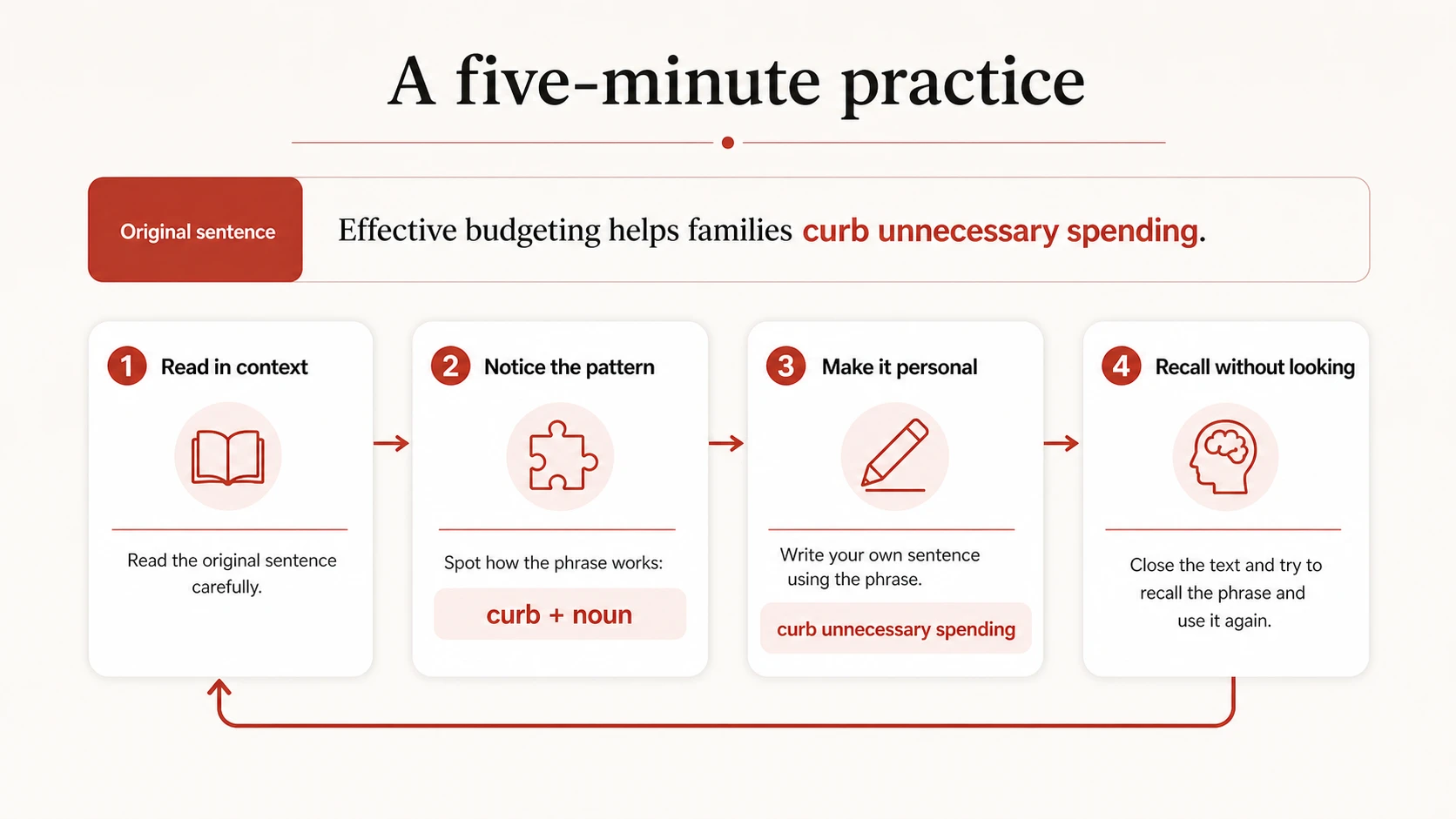
Suppose you read this sentence in an article:
The company is trying to curb unnecessary spending.
First, keep the useful phrase curb unnecessary spending. From the sentence, you can infer that curb means to control or limit something undesirable. Next, notice the pattern: curb + noun. You may later encounter curb inflation, curb emissions, or curb the spread of misinformation. Now create a personal sentence: “We introduced a smaller approval limit to curb impulse purchases.” Finally, revisit the word a few days later and try to complete a new prompt: “The city introduced new rules to curb ___.”
That short sequence does more than repeat a definition. It moves from context to pattern, from pattern to personal use, and from personal use to fresh retrieval. That is the basic motion of generative learning.
How Do You Know a Word Has Become Generative?
You do not need perfect mastery. A word is becoming generative when you can do several of the following without copying the original sentence:
- explain it in simple language;
- recall a common phrase containing it;
- choose the right grammatical form;
- create a true sentence of your own;
- recognize a different but related use;
- avoid a combination that sounds unnatural.
There will still be gaps. You may know strong evidence but not instinctively avoid powerful evidence. Those corrections are part of the process. Flexible vocabulary grows through use, feedback, and repeated contact—not through one final moment of “completion.”
Common Mistakes That Keep Vocabulary Passive
The first is collecting too many words. A crowded list creates the pleasure of acquisition but leaves little time for retrieval or reuse.
The second is saving only translations. Translation can clarify meaning quickly, but it rarely shows register, grammar, or collocation.
The third is reviewing in exactly the same format every time. If the cue never changes, the learner may memorize the card rather than the word.
The fourth is forcing rare words into conversation. Generative vocabulary is not about sounding sophisticated. It is about having language that fits the situation. A common phrase used naturally is more valuable than an impressive word used awkwardly.
If you want a broader system for turning reading into long-term vocabulary, see how to build vocabulary and how to learn vocabulary in context. A context-aware vocabulary builder can make the capture and review steps easier, but the goal remains the same: use what you learn in a new situation.
Frequently Asked Questions
Is generative vocabulary the same as active vocabulary?
They overlap, but the emphasis is slightly different. Active or productive vocabulary refers to words you can use. Generative vocabulary highlights flexibility: whether you can adapt those words across new sentences, forms, and contexts.
What is an example of generative vocabulary?
If you learn draw a conclusion in one article and later produce “It is too early to draw a firm conclusion,” you are using the phrase generatively. You retained the pattern and adapted it to a new message.
Can beginners build generative vocabulary?
Yes. Beginners can start with high-frequency words and short patterns such as interested in, need to, or the reason for. Generative ability does not require advanced vocabulary; it requires reusable knowledge.
How many words should I study at a time?
There is no universal number. A smaller set that you can revisit, retrieve, and reuse is usually more valuable than a long list you only recognize. For many learners, choosing a few words from something they genuinely read or watched is a sustainable starting point.
How long does it take for a word to become usable?
It depends on the word, your prior knowledge, and how often you meet and retrieve it. A transparent, high-frequency word may become usable quickly. A word with several meanings or unusual grammar usually needs more varied encounters.
From Knowing More Words to Doing More With Them
The useful answer to what is generative vocabulary is not “a special category of difficult words.” It is the vocabulary you can retrieve, reshape, and carry into a new situation.
The shift begins with a modest change in practice: keep context, notice patterns, retrieve before rereading, and make one sentence that matters to you. Over time, words stop feeling like entries in a list. They become material for thought.