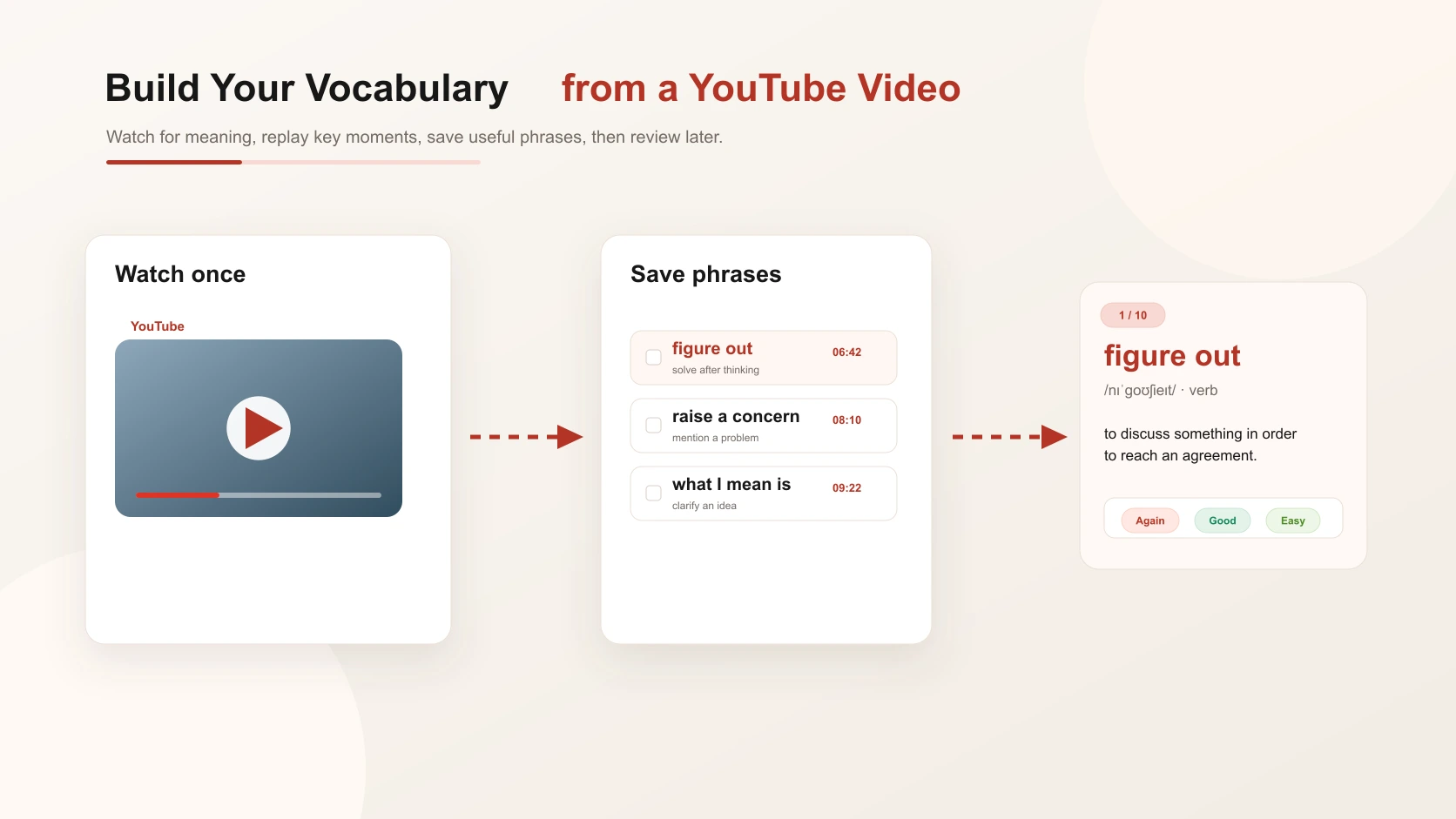
YouTube is one of the richest places to meet real English. You can hear how people explain ideas, disagree politely, tell stories, describe tools, review products, teach concepts, and react in the moment. But there is a catch: watching a video is not the same as learning from it. If you want to build your vocabulary from a YouTube video, you need a workflow. Otherwise, the video ends, the words disappear, and the only thing you keep is the vague feeling that you "understood most of it."
Choose One Video with a Clear Purpose
A good vocabulary video has a clear topic and language you may actually reuse. A ten-minute explainer, interview segment, product review, tutorial, lecture clip, or documentary scene is often better than a random entertainment video.
Before watching, ask yourself:
- Why am I watching this?
- What vocabulary topic do I want?
- Is the speaker clear enough for my level?
- Will I want to use this language later?
If the answer is no, choose a different video. Vocabulary learning works better when the content matters to you.
Watch Once for Meaning
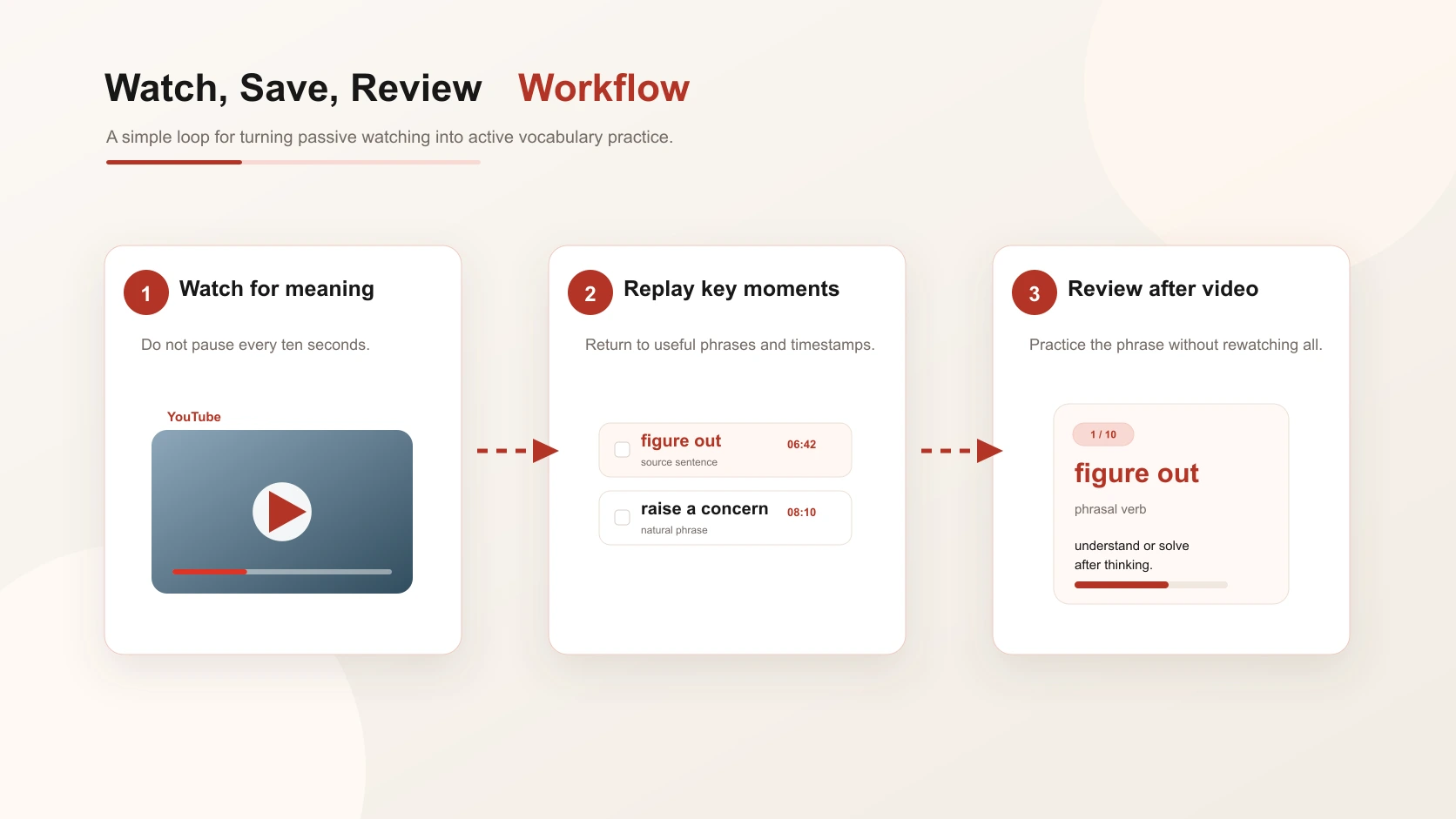
The first watch should be mostly uninterrupted. Do not pause every ten seconds. Do not open a dictionary for every word. Do not try to write a perfect list while the speaker is still explaining the idea.
Your first job is to understand the video.
During the first watch, mark only moments that feel important. You can note a timestamp, write a quick phrase, or simply remember the section. The goal is not to collect. The goal is to notice.
This protects comprehension. If you interrupt too much, you may collect vocabulary but miss the point of the video.
Replay Key Moments
The second pass is where learning begins. Go back to the parts where:
- the speaker explained an important idea;
- a phrase sounded useful;
- you understood the sentence but not one key word;
- the same expression appeared more than once;
- the speaker used a natural phrase you would like to copy.
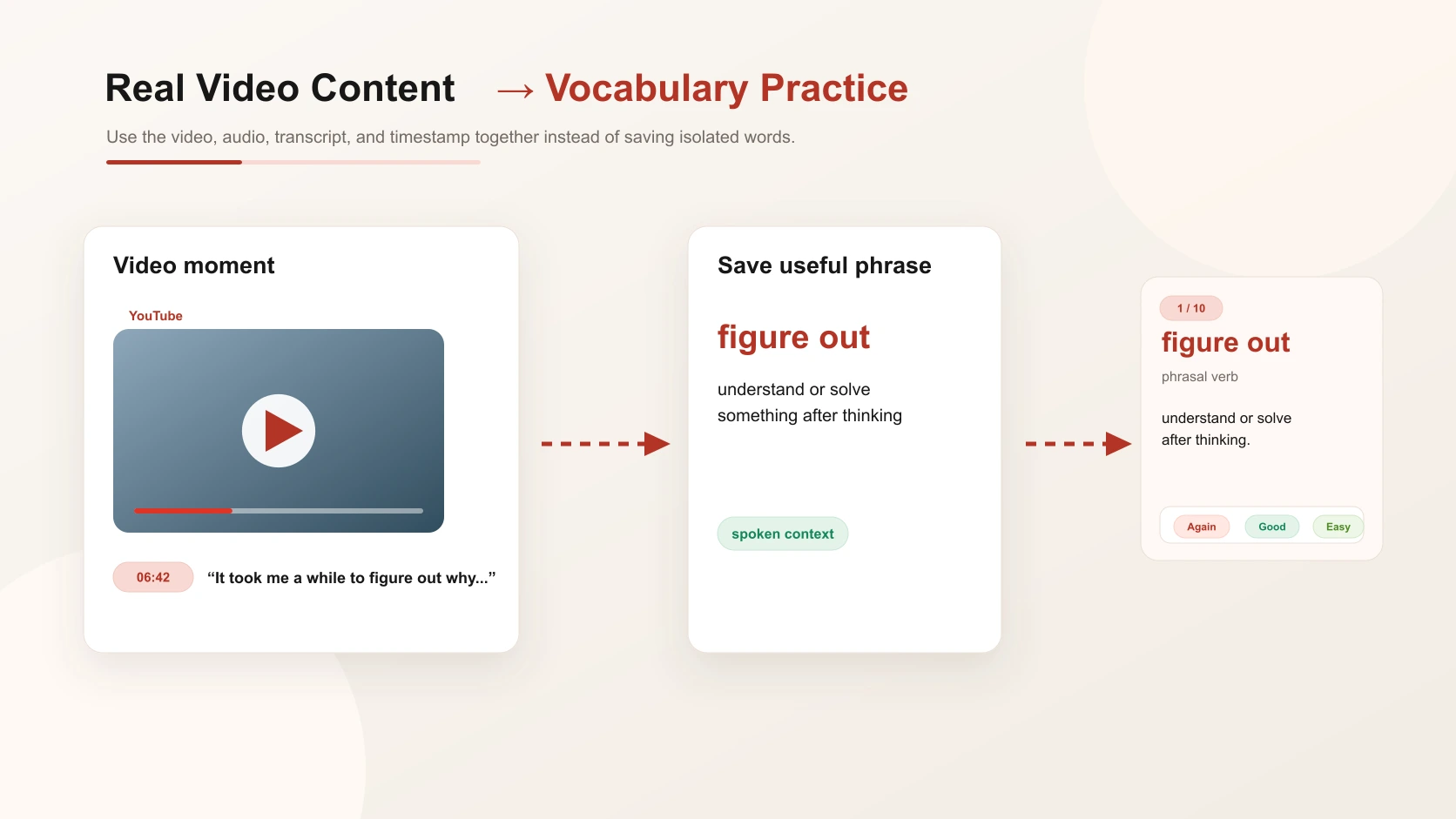
Now pause and save the vocabulary. This is the moment when you can use the transcript if it is available. But the transcript is not the whole workflow. The audio gives you pronunciation, rhythm, stress, and tone. The video gives you context, visuals, and speaker intention. That is why learning from video is different from learning from a word list.
Save Words and Phrases with Timestamps
A useful video vocabulary note should include the time marker.
Weak note: figure out - understand
Better note: figure out - understand or solve something after thinking.
Timestamp: 06:42
Source: "It took me a while to figure out why the tool kept failing."
My example: I finally figured out how to organize my notes.
The timestamp lets you return to the sentence and hear how it was spoken. This is especially helpful for phrases, contractions, reductions, and informal speech. If your goal is to build your vocabulary from a YouTube video, do not ignore spoken delivery. A phrase may look simple in text but sound very different in real speech.
Prioritize Reusable Language
Not every unknown word deserves a place in your list.
Prioritize:
- topic terms you will meet again;
- phrases that native speakers use naturally;
- collocations, such as "raise a concern" or "make an assumption";
- discourse phrases, such as "what I mean is" or "the point is";
- words that help you explain your own ideas.
Skip:
- names you do not need;
- one-time references;
- rare words unrelated to your goals;
- captions that are probably wrong;
- words you understand but will never use.
This keeps your list reviewable. A short list from one video is stronger than a huge list you abandon.
Use the Transcript Carefully
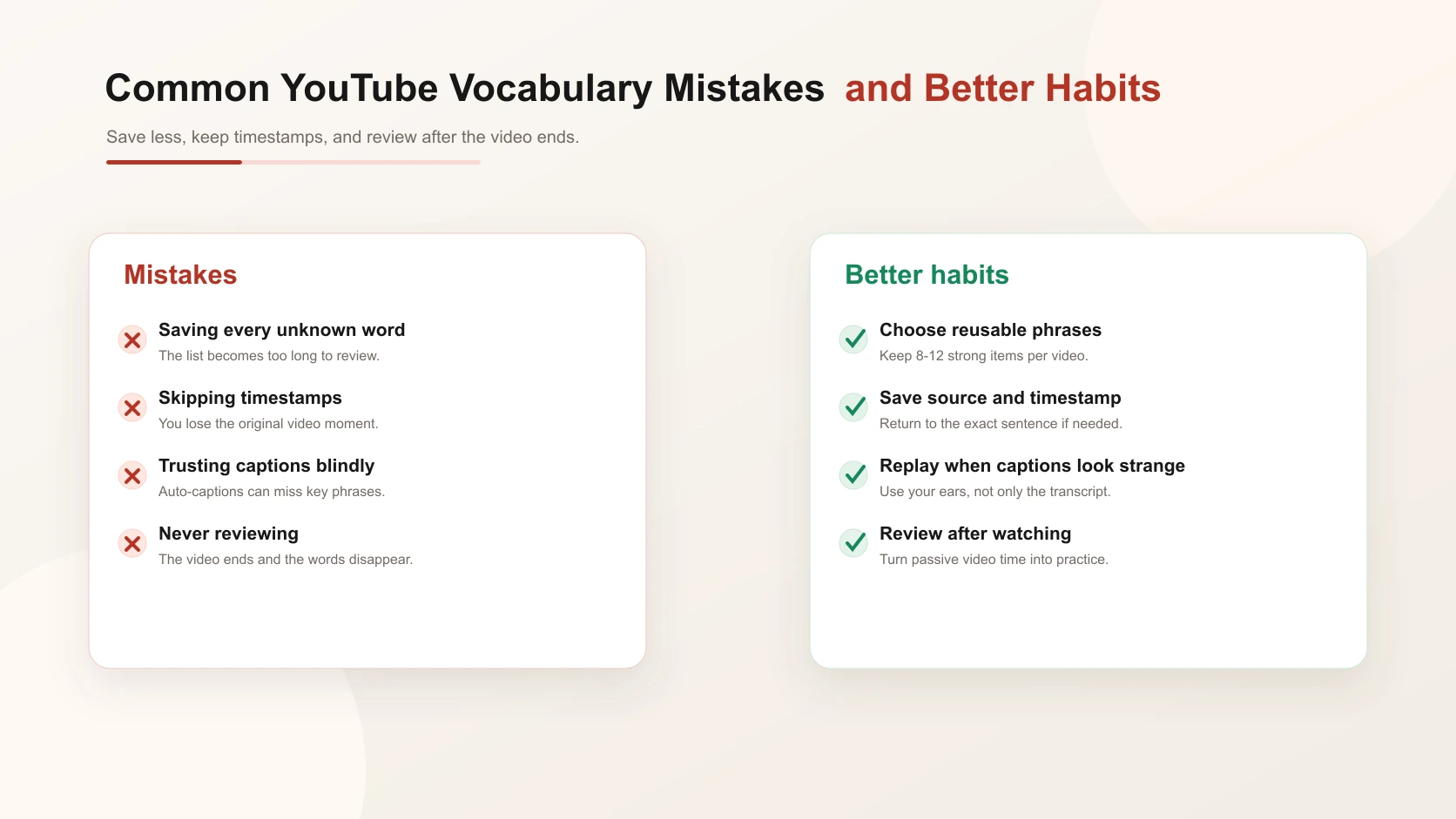
If the video has a transcript, use it as support. It can help you copy sentences accurately and find timestamps. But do not trust it blindly. Auto-captions may miss names, technical terms, fast speech, or overlapping voices. If a transcript line looks strange, replay the audio. Your ears are part of the learning process. For transcript-specific work, read turn a YouTube transcript into a vocabulary list. This article is broader: it is about how to learn from the video experience itself.
Review After the Video Ends
Once you finish, review the list without playing the full video again. Try this:
- Read the phrase.
- Remember the video moment.
- Explain the meaning in your own words.
- Write one sentence about your life, work, or study.
- Replay the timestamp only if you cannot remember the usage.
This turns passive watching into active vocabulary practice. A tool like ClaviSay can help when you want to keep vocabulary connected to the real content where you found it, but the habit matters more than the tool: save context, review later, and use the word yourself.
A 20-Minute Practice Routine
Here is a simple routine:
- Minute 0-2: choose one video and set a goal.
- Minute 2-12: watch once without heavy pausing.
- Minute 12-17: replay important moments and save 8-12 words or phrases.
- Minute 17-20: write your own example sentences.
This is enough for one session. You do not need to master the whole video immediately. You only need to leave with a small, useful set of language.
Common Mistakes
The first mistake is saving too many words. If the list is too long, review becomes unpleasant.
The second mistake is learning only from subtitles. Subtitles help, but spoken language includes sound, timing, and emphasis.
The third mistake is choosing videos that are too difficult. If you understand almost nothing, vocabulary learning becomes guessing.
The fourth mistake is never reviewing. Watching feels productive, but vocabulary grows when you return to the words.
How ClaviSay Fits Into This Workflow
When you want a more structured workflow, the Vocabulary Builder page shows how saved vocabulary can stay connected to source content, meaning, and later review. For a tool-focused video workflow, see YouTube to vocabulary.
Final Thoughts
To build your vocabulary from a YouTube video, treat the video as real content, not background noise. Watch first for meaning, replay useful moments, save words with timestamps and source sentences, and review after the video ends.
If you already have transcript text, use the transcript-specific guide mentioned above. For a broader method, read learn vocabulary in context, or return to build your vocabulary from a YouTube video when you want the video-specific workflow.
FAQ
How can I build my vocabulary from a YouTube video?
Choose one useful video, watch once for meaning, replay key moments, save useful words and phrases with timestamps, and review them later.
Should I pause every time I hear a new word?
No. Watch once for meaning first. Pause during the second pass when you are selecting useful vocabulary.
Is the transcript enough for learning vocabulary from YouTube?
The transcript helps, but audio and video context matter too. Use the transcript to support the video, not replace it.
How many words should I save from one video?
Usually 8-15 useful words or phrases are enough for one review session.