When English content gets hard, most learners reach for the same tool: a translator. Paste the sentence, read the result, move on. It works, in the sense that you get an answer fast. But anyone who has done it for a while notices something odd — the more you translate, the less you actually seem to learn. You understand in the moment and forget by the next day.
There is a reason for that, and it points toward a different approach: bilingual reading. The two methods look similar from the outside — both involve your own language helping you with English — but they work in opposite directions. This guide compares bilingual reading vs translation directly, so you can tell when each one helps, when each one gets in the way, and how to combine them without wasting your time.
What each method actually does
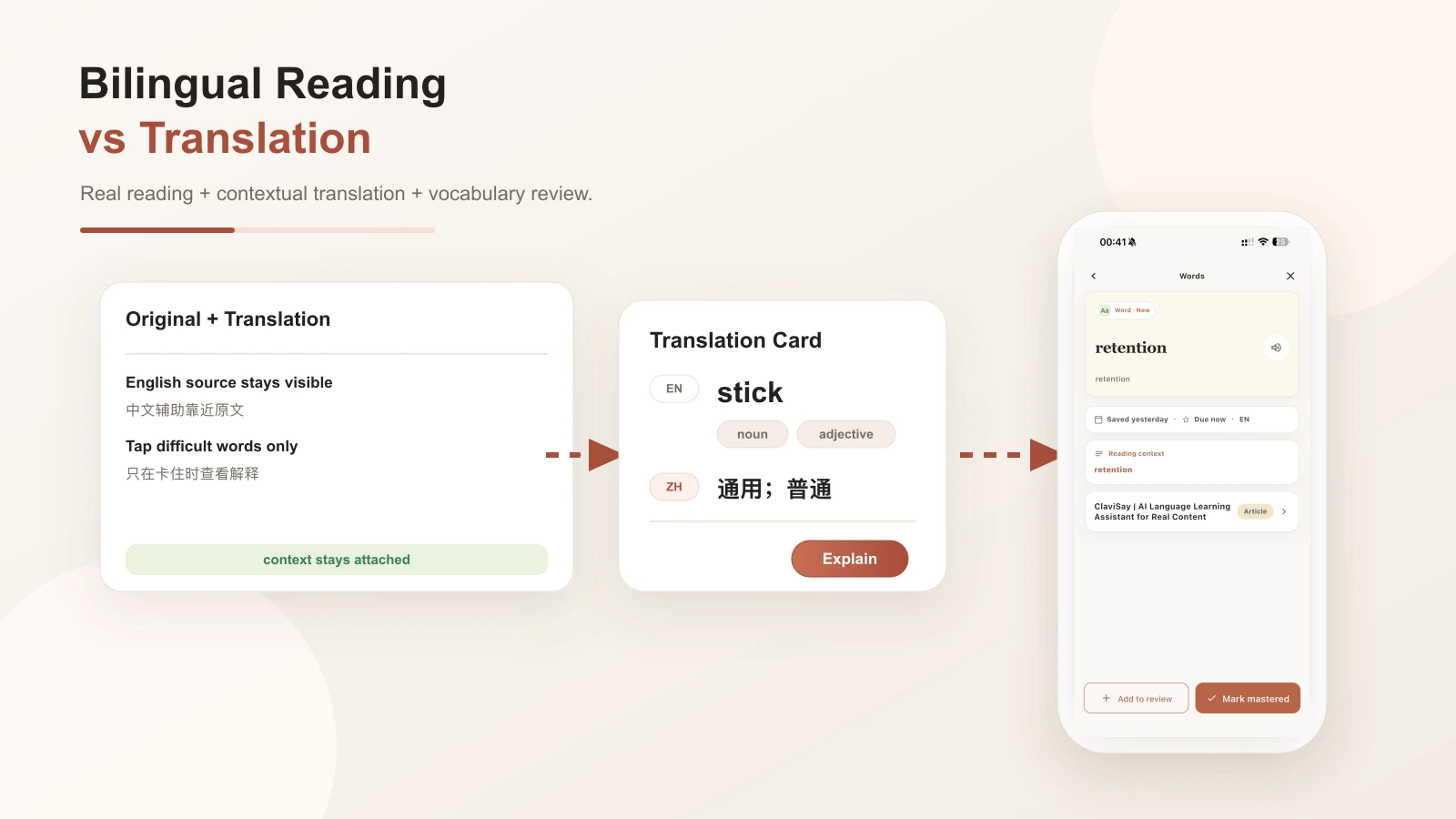
Translation replaces the original
Translation takes an English sentence and swaps it for a version in your language. The original leaves the room. You read the result, extract the meaning, and the English itself becomes optional. This is great when you just need the information and terrible when the English is what you are trying to learn, because you never actually engage with it.
Bilingual reading keeps the original in front of you
Bilingual reading leaves the English where it is and brings your language in alongside, usually as a side-by-side column or an on-demand explanation. You read the original first and lean on the support only when you need it. The English never leaves the room, which is why bilingual reading teaches and translation, used alone, mostly does not.
If you want the concept laid out from scratch, our guide on what bilingual reading is covers the basics before diving into the comparison here.
Bilingual reading vs translation: a side-by-side
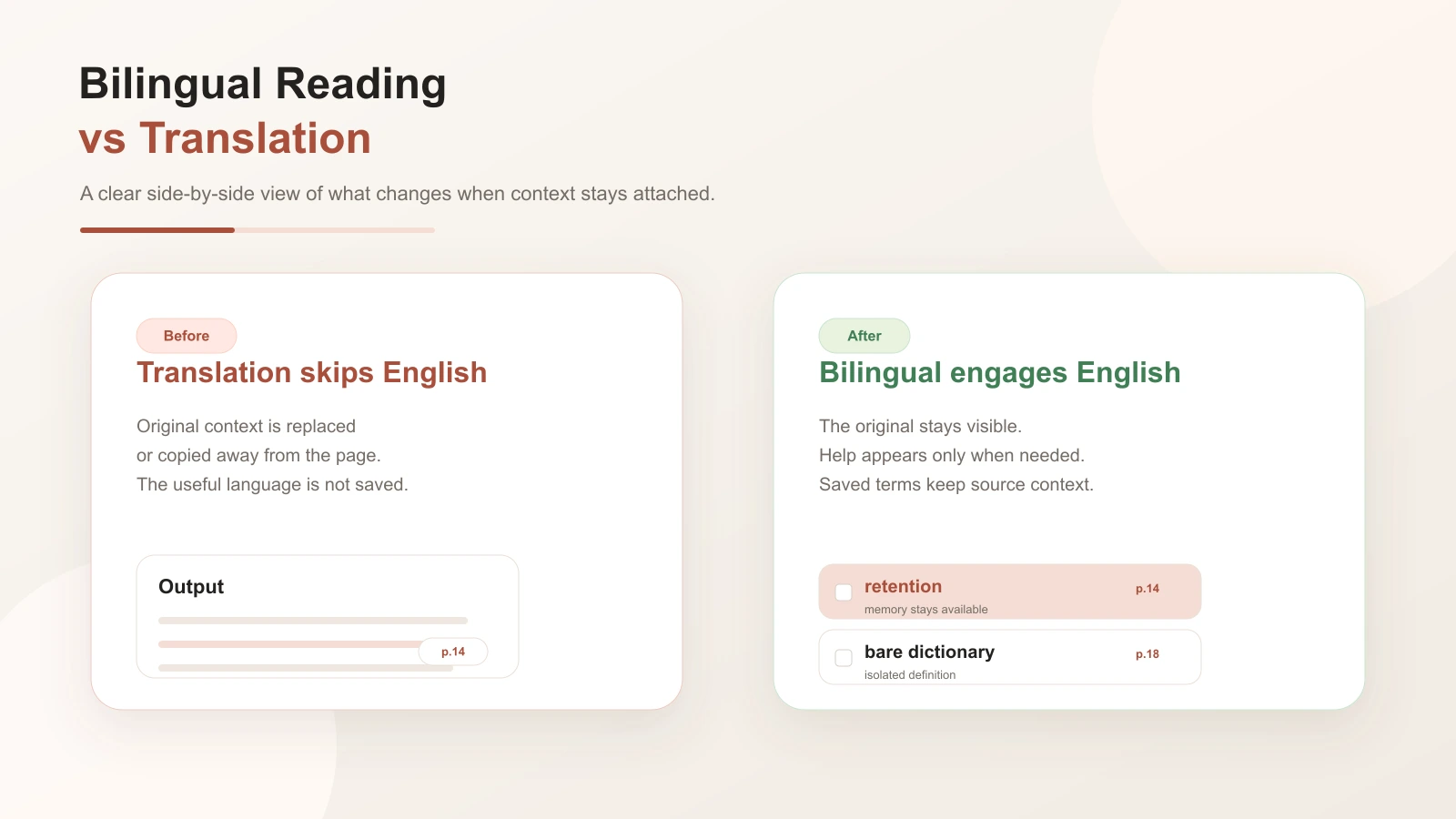
The differences show up clearly once you line them up. Here is how the two compare on the things language learners actually care about.
- Engagement with the source: translation lets you skip the English; bilingual reading forces you to read it.
- Reading speed: full translation is faster if you only want the gist; bilingual reading is slower but keeps you learning.
- Vocabulary retention: translation produces almost none, because you never meet the words in a form you keep; bilingual reading produces real vocabulary when you save words with their sentences.
- Accuracy on hard sentences: both can mislead, but bilingual reading lets you compare the two versions side by side and catch mistakes.
- Long-term effect: translation builds dependence; bilingual reading builds independence, because you need the support less over time.
On balance, for anyone whose goal is to improve at English rather than just survive a single document, bilingual reading wins on almost every measure that matters. Translation is a tool you keep in the drawer for emergencies; bilingual reading is the daily practice.
When translation is the right call
None of this means translation is bad. It is the correct tool whenever the language is not the point. A one-off document you need to extract information from, a notice you just have to understand once, a contract clause where you need certainty fast — in all of these, translating is faster and good enough. Trying to read these bilingually for the vocabulary would be a waste of time.
Translation is also useful as a check inside bilingual reading. When a sentence does not make sense even with support, pulling up a full translation of that sentence can confirm what you suspected or surface an error in your reading. The problem is not translation itself; it is reaching for whole-document translation as your default for everything you read.
Why bilingual reading wins for learners
The deeper reason bilingual reading beats translation for learning is effort distribution. With translation, the effort is front-loaded into producing a result, and then zero — you just read the output. With bilingual reading, the effort is spread across the whole reading session, in small amounts, exactly where you need help. That distributed effort is what builds skill, because your brain is doing the work of reading the English and only borrowing support at the edges.
Over time, the support you need shrinks. Sentences that used to stop you start to make sense on the first read. The vocabulary you saved from earlier articles shows up in new ones and feels familiar. None of this happens when you read finished translations, because the original English never has to do any work in your head. For a practical version of how to apply this to articles, see how to read English articles with translation support.
How to use both without wasting time
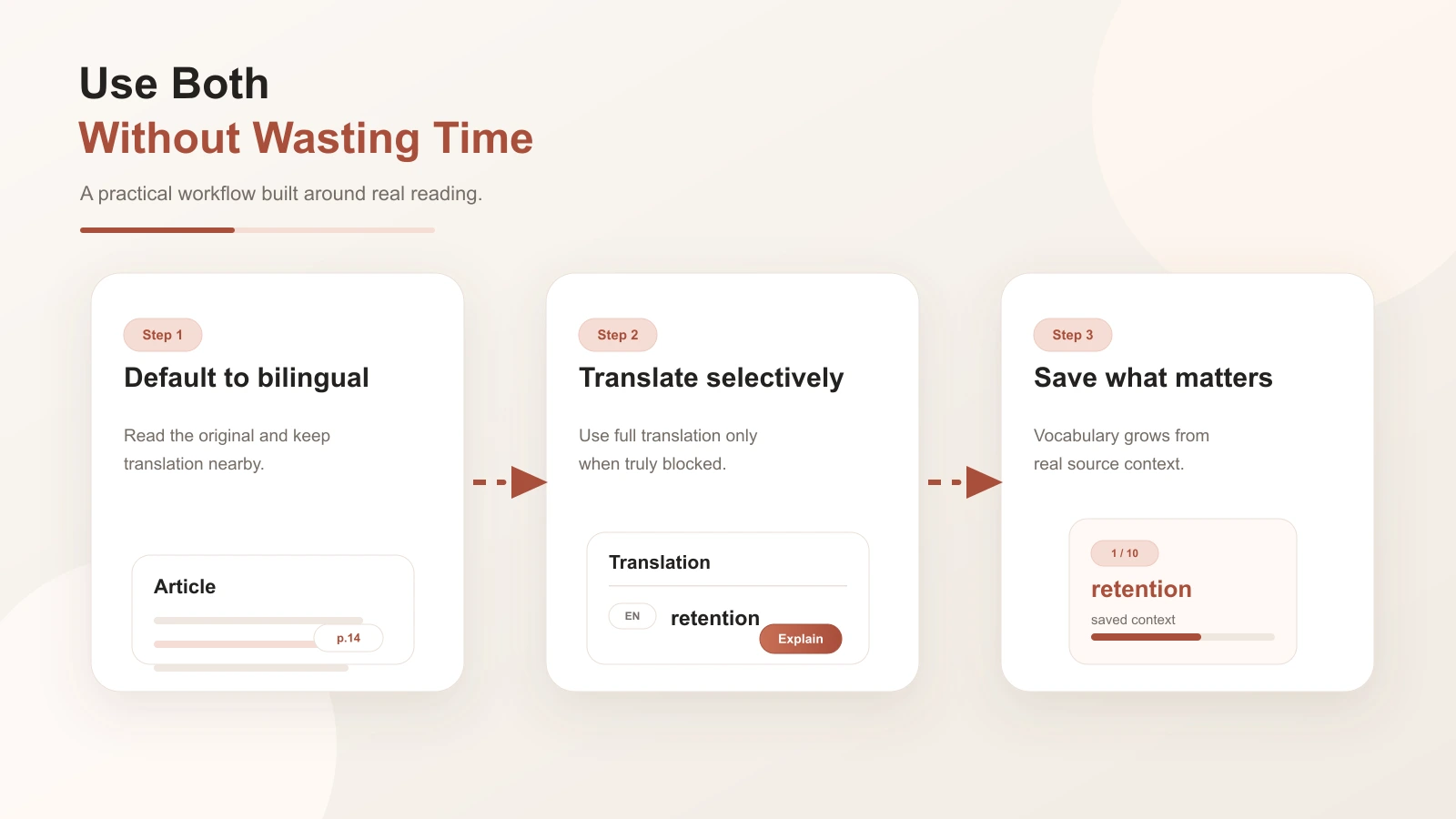
The best setup for most learners is bilingual reading as the default and translation as an occasional tool. Read real content in a bilingual view, get explanations where you need them, and save the words worth keeping. Reach for full translation only on the rare sentence that defeats everything else, or on documents you genuinely just need to skim.
A few rules keep this efficient. Read the English first, before looking at any support, so you actually try. Save vocabulary with the original sentence, not as a bare definition, or you lose most of the benefit. And do not translate entire passages by default — most of the time a sentence-level explanation is enough, and over-translating buries the parts worth learning.
If you want this built into a workspace, the bilingual reading tool is designed around exactly this balance. Bookmark this comparison of bilingual reading vs translation for later, and the wider ClaviSay reading ecosystem lets you bring the same approach to PDFs, webpages, and videos.
Choose the method that matches your goal
Bilingual reading vs translation is not really a competition; it is a choice of tool for the job in front of you. When you need information fast and the language does not matter, translate. When you want to understand and improve, read bilingually, keep the original in view, get help where you need it, and save the vocabulary worth keeping. Get that balance right and your reading time finally starts to produce language that stays.