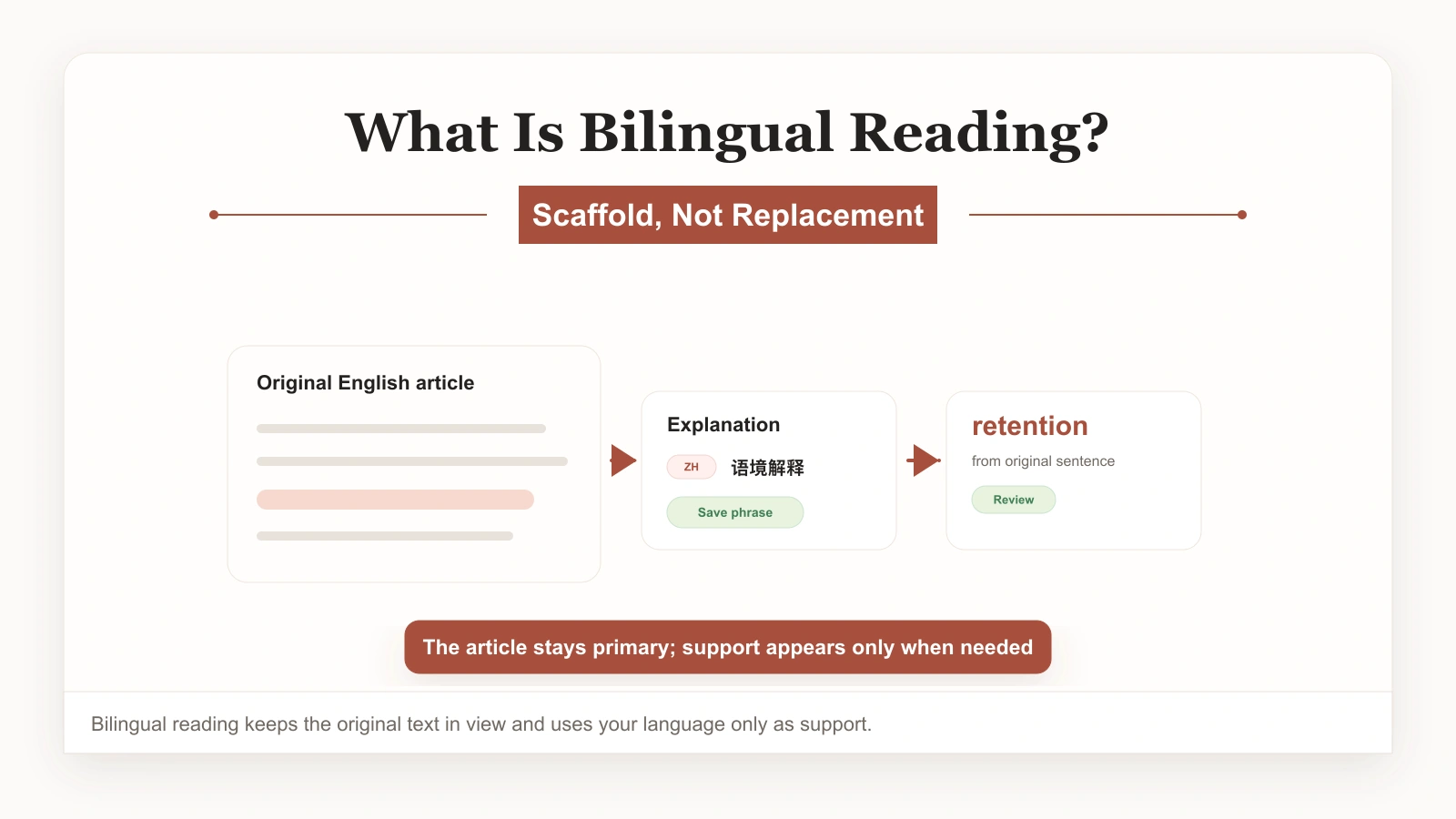
If you have ever read an English article with a translation open in another tab, you have already done a rough version of bilingual reading, even if you did not call it that. The term sounds technical, but the idea is simple: you read a text in its original language and use your own language to help you understand it. The original stays in front of you. The support arrives only where you need it.
This guide explains what bilingual reading is in plain terms, how it differs from plain translation, why it works for language learners, and how to actually do it. If you have been translating everything and wondering why your English is not improving, this is the concept that explains the gap and the fix.
What bilingual reading means, in practice
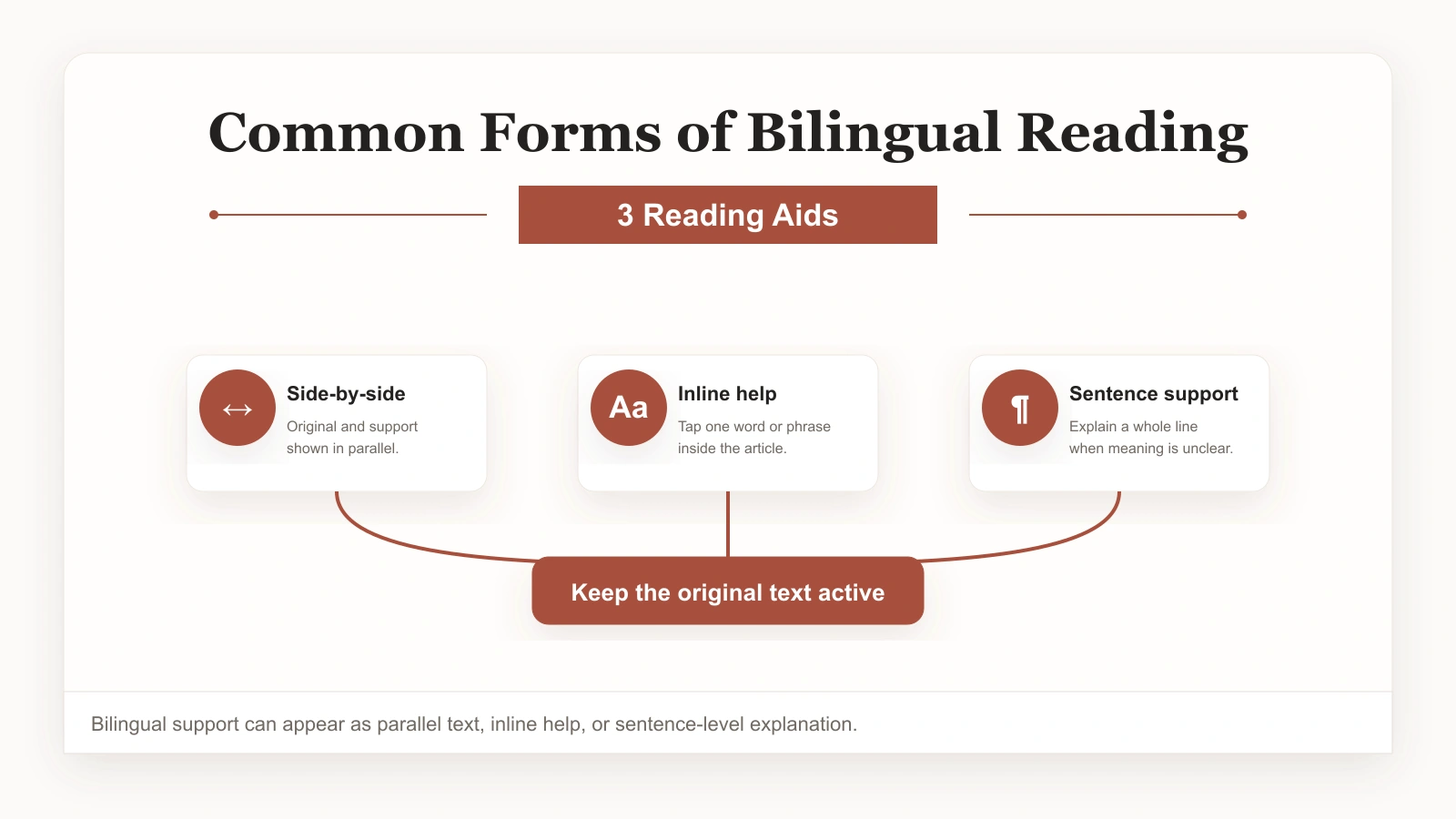
At its core, bilingual reading is reading with a second language as a scaffold rather than a replacement. In practice it usually shows up in one of a few forms: a two-column layout with the original text on one side and your language on the other, an inline explanation that appears when you tap a word, or a sentence-level translation you can pull up when a whole line is unclear. The common thread is that the original text is always there, and the support is something you choose to use rather than something that takes over.
This is what makes it different from casual translation. When you copy a paragraph into a translator, the original leaves your attention — you read the result and move on. In bilingual reading, the original never leaves your attention. You read it first, struggle a little, and use the support precisely where the struggle happens. That small difference in where your attention goes is the entire reason bilingual reading teaches and plain translation mostly does not.
It also means bilingual reading scales with you. When you are starting out, you lean on the support heavily. As you improve, you need it less. The same article that needed a translation on every sentence last year might need help on only two this year. The scaffold gradually comes off, which is the whole point.
Bilingual reading vs translation, in one paragraph
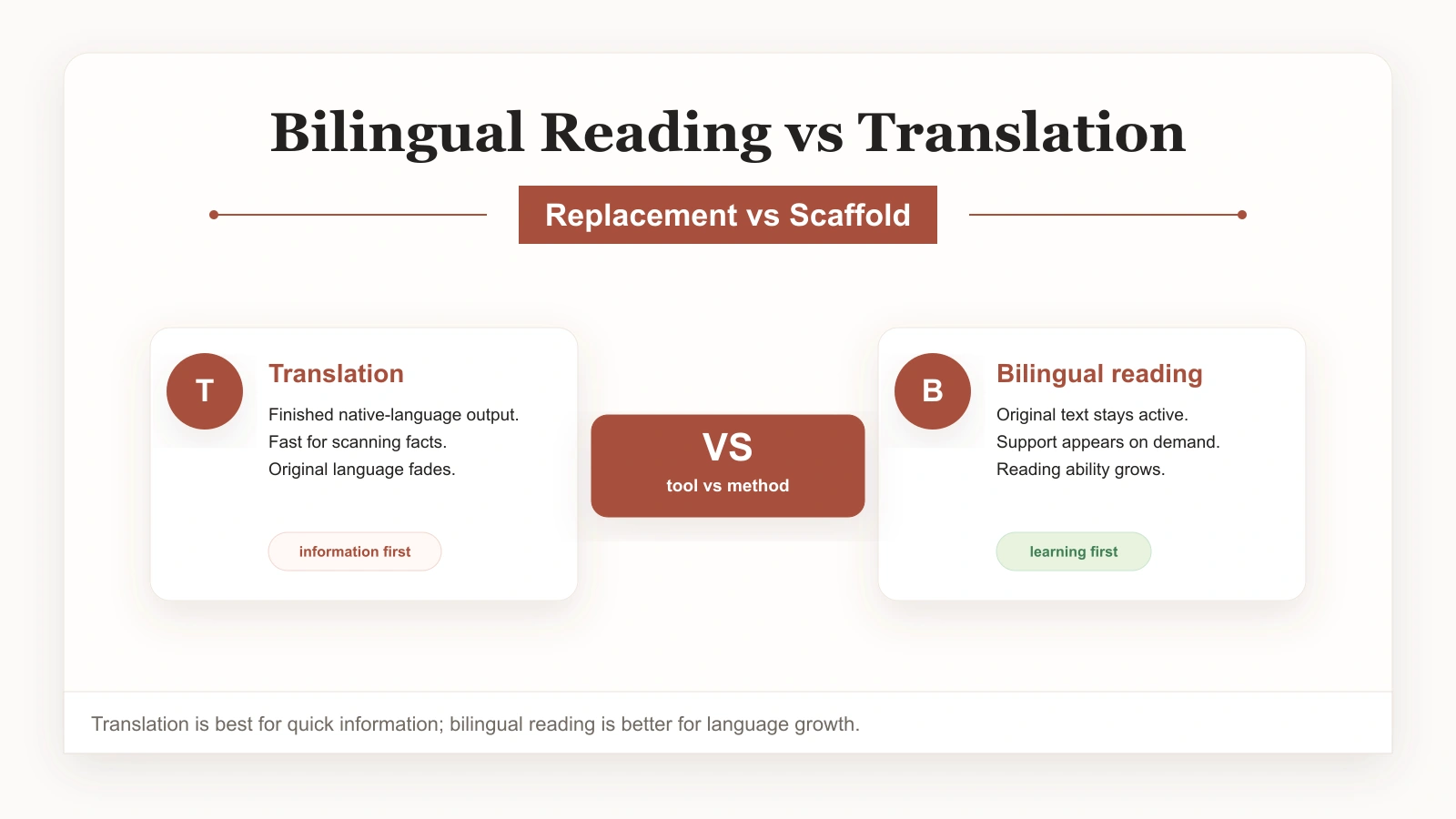
Translation hands you a finished version in your language; bilingual reading keeps the original and adds support. Translation is faster when you only need the information; bilingual reading is slower but actually builds your ability to read the language. Translation builds dependence on translation; bilingual reading builds independence from it. If you want the full comparison, our guide on bilingual reading vs translation lays out exactly when each one wins. For now, the short version is: translation is a tool for getting information, bilingual reading is a method for getting better at a language.
Why bilingual reading works for language learners
Three things make bilingual reading effective where pure translation fails. The first is engagement. Because you read the original first, your brain actually processes the target language instead of skipping it. Engagement is the entry requirement for any learning, and translation removes it.
The second is context. A word you meet inside a real sentence, about something you are reading, is far easier to remember than a word on a flashcard with no situation attached. Bilingual reading keeps vocabulary inside its context, so the words you pick up come with the sentences that made them meaningful.
The third is retention through saving. Because bilingual reading happens inside a real reading session, you can save the words worth keeping as you go, each one tied to its original sentence. Over weeks, that builds a vocabulary collection that came from content you actually chose, which is the kind of vocabulary that survives. None of this happens when you read finished translations, because the original never does any work in your head.
Who bilingual reading is for
Bilingual reading suits almost anyone who reads content in a language they are still learning. Students reading papers in English, professionals handling reports and emails, researchers working through sources, and casual learners following news or blogs all benefit. If you read English content regularly and want to understand it better while gradually needing less help, bilingual reading is built for your situation.
It is not a beginner-only technique, either. Intermediate and advanced learners often get the most out of it, because they can read most of a text on their own and only need support on the genuinely hard parts. The support you need shrinks as you improve, which is exactly the feedback loop you want.
How to start, simply
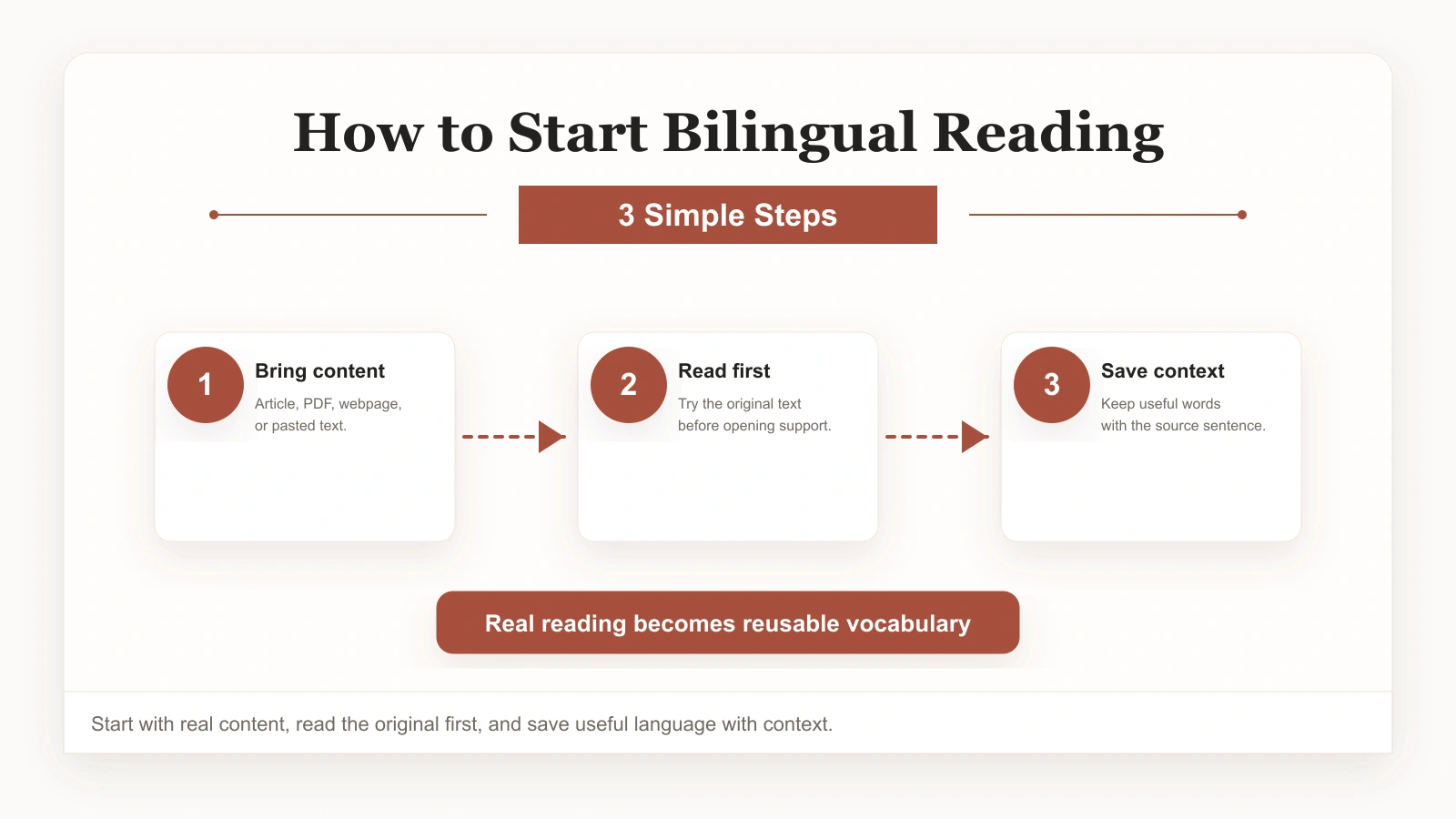
You do not need much to begin. Bring a real article, PDF, or page you want to read into a reading workspace that supports on-demand translation, read the original first, and pull up an explanation only where you get stuck. Save the words worth keeping with their sentences, and review them briefly and often.
The articles matter more than the method. Read what you would read anyway — news in your field, blogs on your hobbies, work documents you have to handle — because interest is what makes you notice and remember. Bring the bilingual reading habit to content you already chose and vocabulary starts to accumulate almost on its own. For a focused workflow on the most common case, see our guide on reading English articles with translation support.
A few misconceptions worth clearing up
- Bilingual reading is not cheating. Using support to read the original is exactly how you learn; avoiding all support usually just means you stop reading.
- It is not the same as reading a translated version. The original has to stay in view, or you are just translating.
- It does not require a fixed library of bilingual texts. The best bilingual reading happens on content you chose yourself.
- It will not keep you dependent forever. Done right, you need the support less over time, not more.
- It is not only for beginners. The more advanced you are, the more selectively you use the support, and the more efficient the practice becomes.
The short answer
So what is bilingual reading, in one line? It is reading a text in its original language with your own language available as support, used on demand, never as a replacement. If you are still asking what is bilingual reading after everything above, the test is simple: if the original is in front of you and your language is there to help rather than to take over, you are doing it. The original stays in view; the help arrives where you need it; the words worth keeping get saved with their context. That is the whole idea, and it is the single most practical way to turn reading time into real language growth.
If you want to try it on your own content, the bilingual reading tool is built around exactly this. Save this primer on what bilingual reading is to revisit later, and the wider ClaviSay reading ecosystem extends the same approach to PDFs, webpages, and videos across web, browser, and mobile.