Almost everyone who learns English reads articles. News, blogs, newsletters, research summaries, work documents — for a lot of learners it is the single biggest source of contact with the language. And yet, most of that reading produces almost no new vocabulary. People read for years, encounter thousands of useful words, and somehow finish with very little to show for it.
The gap is not effort. It is method. Reading alone does not build vocabulary; reading plus a small set of habits does. This guide covers how to build vocabulary while reading real articles in a way that turns time you are already spending into language that actually stays with you.
Why reading alone rarely builds vocabulary
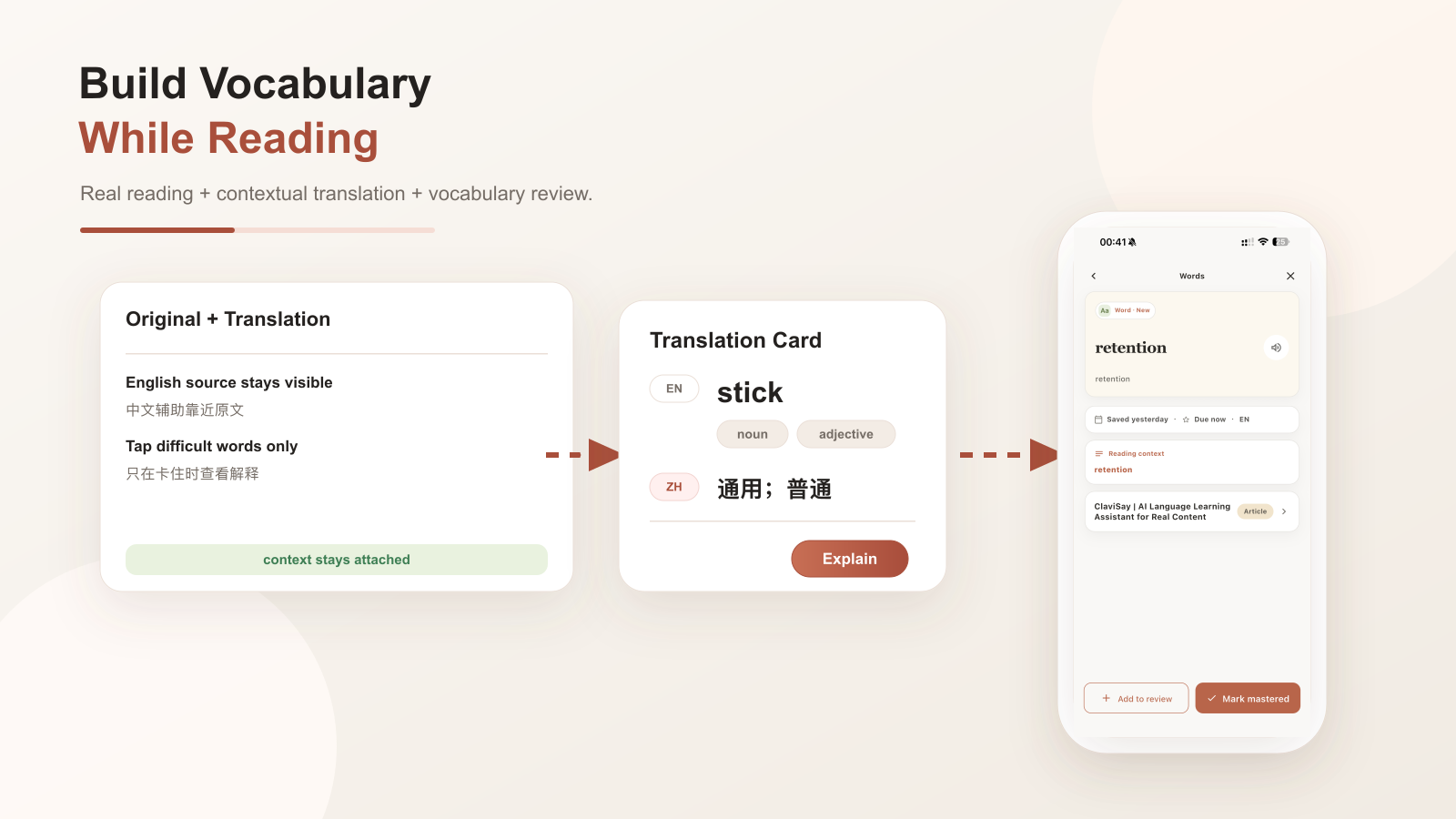
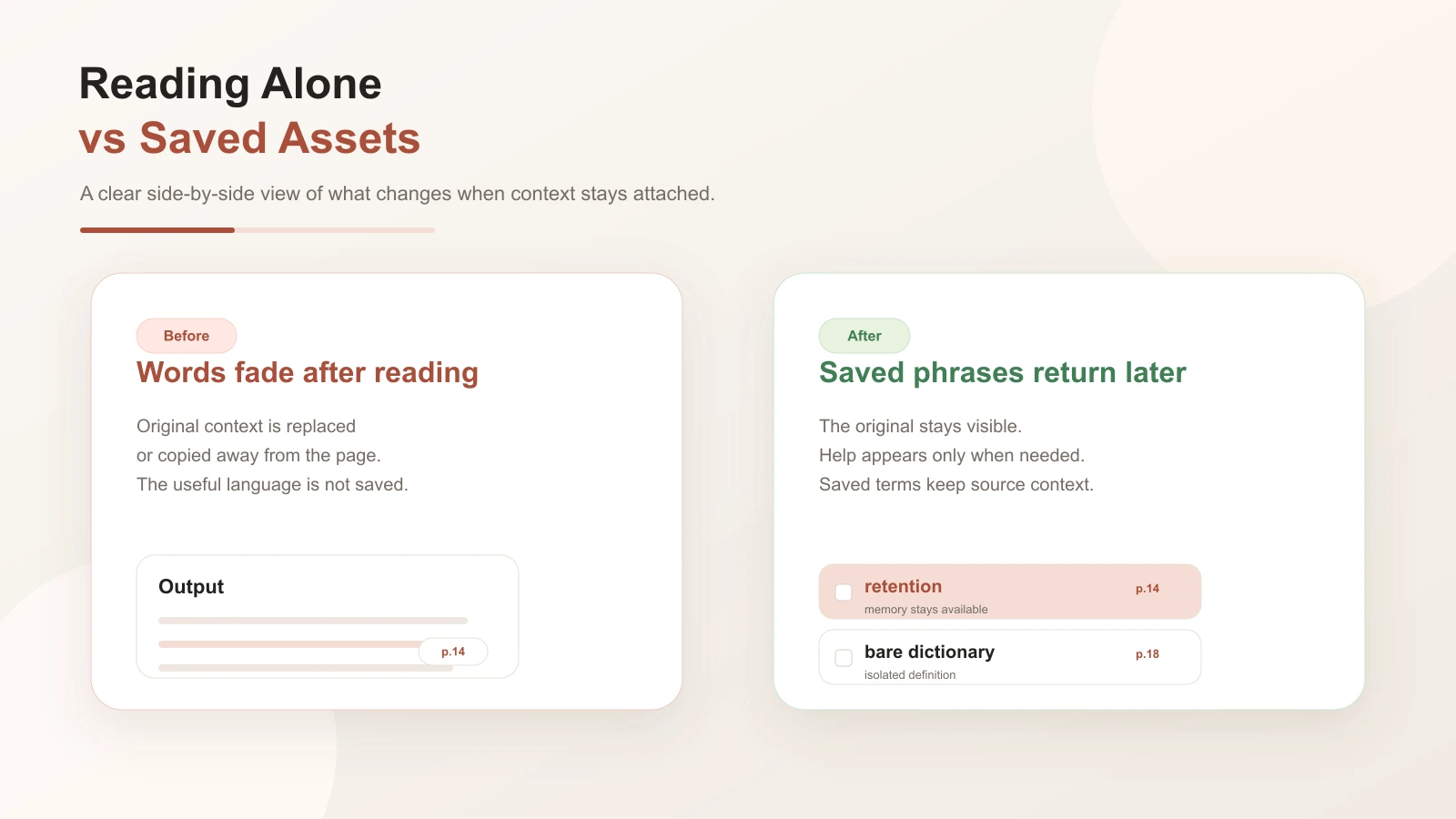
Reading is excellent input, but input by itself is fragile. You meet a word, you roughly understand it from context, and you keep going. The rough understanding feels like learning, but your brain has no reason to keep the word, so it fades. A few days later you meet the same word in a different article and it feels new again. Repeat this for a year and you have read an enormous amount and retained very little.
The missing piece is a capture step. The readers who improve are not the ones who read more; they are the ones who, in the middle of reading, take a moment to grab the words worth keeping and hold onto them with their context. That is the entire difference, and it is a small habit to add.
When you build vocabulary while reading real articles this way, two things happen at once. You keep reading at a normal pace, so you do not turn every session into a study chore. And the words you save come with the sentences you met them in, which is what makes them retrievable later.
The habit that does the work: read, notice, save
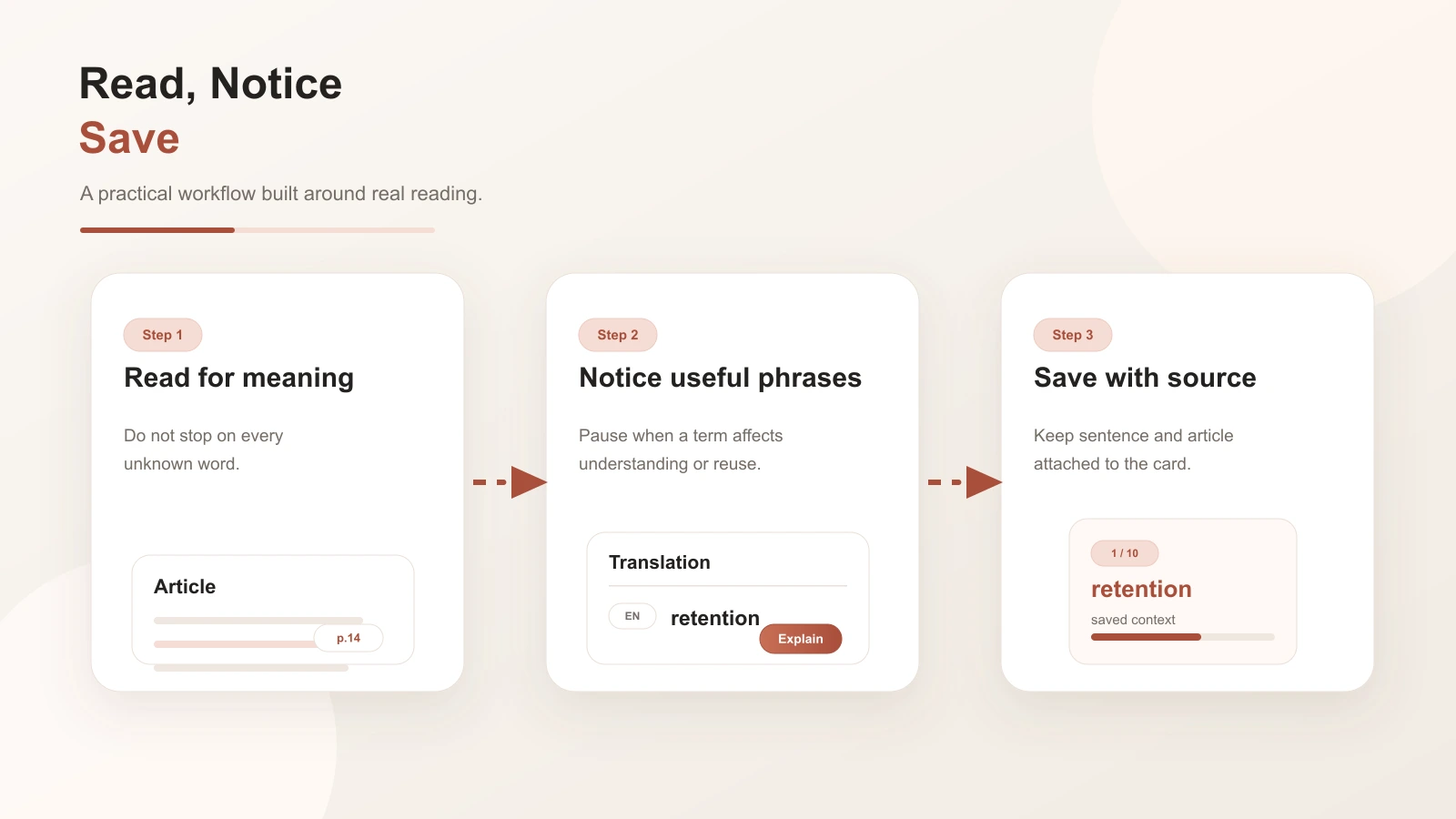
The core loop is three moves, repeated whenever something catches your attention.
Read first, look up second
Read the article for meaning, the way you normally would. Only when a word genuinely stops you — not on every unfamiliar item — do you pause. Looking up everything kills your flow and teaches you to read like a dictionary exercise. Reading first keeps you engaged with the actual content.
Get the meaning in context
When you do look a word up, get a meaning grounded in the sentence in front of you, not a bare dictionary definition. A definition in isolation is hard to remember; the same definition attached to a real sentence about something you were just reading about is easy. Context is what turns a lookup into something your brain keeps.
Save the ones worth keeping
Not every word deserves a place in your vocabulary library. Save the ones that matter — terminology in your field, useful phrases, anything that made a sentence click — and skip the rest. The point is a curated set of words you actually want to use, not a bloated list you will never review.
If you want this expressed as a single repeatable workflow, our guide on saving vocabulary from articles without breaking your reading flow walks through the mechanics in detail.
Read the articles you actually care about
A surprising amount of vocabulary advice tells you to read things you would never choose on your own, on the theory that “better” material builds “better” words. It does not work that way. Vocabulary sticks when you care about the content, because caring is what makes you notice, look up, and remember.
Read what you would read anyway. If you follow tech news, read that. If you are into a sport, read match reports. If you read research papers for a degree, read those. The vocabulary you meet in content you chose is the vocabulary you will actually use, which is the only kind worth saving. This is also why a fixed reading list from a language app tends to underperform — it disconnects learning from your real interests.
The same principle applies across formats. If articles are your main input, build vocabulary while reading real articles. If you spend more time on video, the same capture habit works on transcripts — see how YouTube to Vocabulary Bilingual Reading PDF Translator applies the identical workflow to videos.
Make review part of the routine
Saving vocabulary is only half the job. The other half is coming back to it. Words you save but never review are only marginally better than words you never saved. A short, regular review session — a few minutes a day — is what moves saved words from “vaguely familiar” to “actually usable.”
The good news is that review works far better when each word carries its original sentence. Instead of drilling an abstract list, you revisit real moments of reading, which is faster and sticks longer. Over a few weeks, the words you saved from articles start showing up in your own writing and speech without effort, which is the real proof that vocabulary has been built rather than just collected.
If you want a fuller picture of how context drives retention, our guide on learning vocabulary in context goes deeper on why context matters and how to use it.
Small habits, compounding results
You do not need to read more to build more vocabulary. You need to read the same amount, slightly differently. Read for meaning, look up only what stops you, save the words worth keeping with their sentences, and review them briefly and often. That loop, repeated across the articles you were going to read anyway, is how reading finally turns into real, lasting vocabulary growth.
If you want a workspace built around this loop, ClaviSay is designed to help you read real articles, get in-context explanations on demand, and save vocabulary that flows into review across web, browser, and mobile. For more on the daily habit, revisit our guide on building vocabulary while reading real articles.